

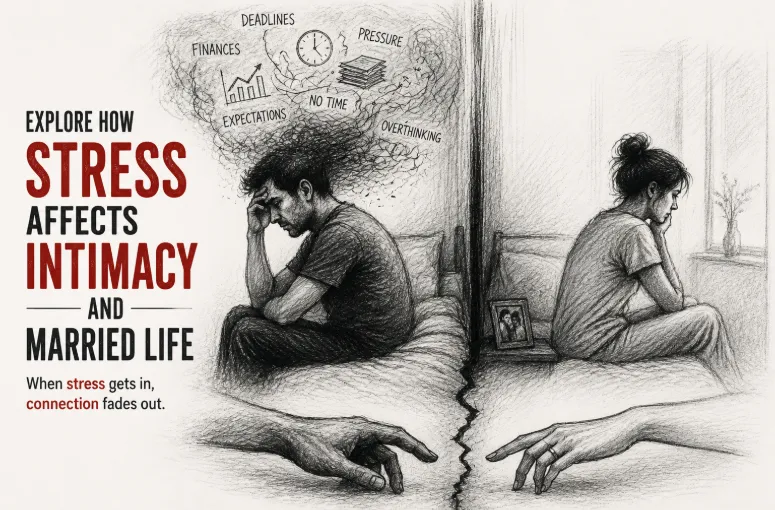

How Stress Affects Intimacy and Married Life
Stress can affect married life by reducing emotional availability, physical affection, sexual desire, communication and quality time. Work pressure, financial concerns, family responsibilities, poor sleep and exhaustion can gradually create emotional distance between partners. This does not necessarily mean love or attraction has disappeared; understanding the source of stress and creating small opportunities for connection can help couples reconnect.
- Stress can quietly damage intimacy: Work pressure, financial worries, family responsibilities and exhaustion can make couples feel disconnected even when love remains.
- Intimacy Has Many Layers: Stress can affect emotional connection, physical affection, sexual desire, meaningful conversations and shared values, not just sex.
- Distance Can Be Misread: Withdrawal or reduced desire may reflect stress and exhaustion rather than rejection, creating a cycle of misunderstanding between partners.
- Small Connections Rebuild Closeness: Private couple time, clear boundaries around money, simple connection rituals and better recovery can help couples reconnect under stress.
You can love your partner deeply and still feel disconnected from them. Sometimes there is no major fight or obvious problem in the marriage. There is simply work pressure, financial worries, family responsibilities and exhaustion slowly taking away the time and energy that intimacy needs.
In this blog, you will understand how everyday stress can affect emotional, physical and sexual intimacy, why partners may respond to stress differently and which warning signs are easy to overlook. You will also learn practical ways Indian couples can rebuild connection, even when work, family and responsibilities leave very little time for each other.
Why Indian Couples Carry So Much Stress
Indian marriages often exist within a much larger ecosystem of work, family, finances and social expectations. A couple may genuinely love each other and still find themselves with very little energy left for connection. When stress becomes part of everyday life, intimacy can slowly become one of the first things to suffer.
For couples, the problem is not always that the relationship has changed. Sometimes, the lives surrounding the relationship have become so demanding that there is very little space left for the relationship itself.
Work, Commutes and Exhaustion
For many Indian professionals, the working day does not really end when they leave the office. A long commute, calls from clients, messages on WhatsApp and unfinished work can keep the mind occupied well into the evening. Someone may finally reach home physically, but mentally they are still thinking about tomorrow’s meeting, a difficult client or the problem they could not solve during the day.
Research on work-family conflict has shown that pressure from one area of life can spill over into another. When work demands consume time and emotional resources, they can affect how available a person is to their family and partner. The result can be surprisingly subtle. Conversations become shorter. Patience becomes lower. Time together becomes more about getting through the evening than actually connecting.
After working with 1,000+ business owners, Kapiil Guptta has seen this pattern repeatedly in high-performing professionals. A person can be extremely successful, disciplined and productive at work while becoming increasingly unavailable at home. It does not necessarily mean they have stopped caring about their partner. Sometimes, they have simply become so accustomed to operating under pressure that they find it difficult to switch from performance mode to connection mode.
No Privacy
For some Indian couples, finding time together is difficult. Finding private time together can be even harder. Couples living with parents or extended family may have limited opportunities to talk openly, spend time alone or express affection without someone else being around. Even when everyone in the household is supportive, privacy can still be limited.
And privacy is not only about sex. Couples need private space to talk about what is bothering them, discuss difficult emotions, laugh together, resolve disagreements and simply enjoy each other’s company. Without that space, a relationship can gradually become centred around family responsibilities and daily logistics.
This is something that can be easy to overlook when looking at relationship problems. A couple may believe they have become emotionally distant when, in reality, their lifestyle has left very little room for emotional connection. From Kapiil’s experience working with business owners, this distinction matters. Sometimes the first step is not trying harder to fix the relationship. It is creating an environment where the relationship has room to breathe.
Money Stress Comes Home
Money stress rarely stays in the bank account. EMIs, rent, children’s education, business uncertainty and responsibilities towards parents can create a constant background pressure. Even during a normal evening at home, one partner may be thinking about the next payment, while the other is worrying about whether the family is financially secure.
Research has linked financial strain with relationship difficulties and lower relationship satisfaction. Money can become a source of repeated conflict because it represents more than spending. For one partner, a financial disagreement may be about security. For another, it may feel like criticism, lack of trust or pressure to provide more.
This becomes especially relevant for business owners. Financial success does not automatically eliminate financial stress. A business owner may have a successful company while simultaneously carrying responsibility for employees, clients, investors and family members. Kapiil Guptta has worked with more than 1,000 business owners and has seen how this invisible pressure can follow people home. When financial worry starts affecting sleep, energy and patience, the relationship can end up absorbing the impact.
The Invisible Second Shift
For many working women, the workday does not end when they leave the office. There may still be meals to organise, children to manage, household decisions to make and family responsibilities to remember. This is what researchers have described through the idea of the second shift, where paid employment is followed by unpaid domestic work.
The burden is not only about how many tasks someone completes. There is also a mental load involved in remembering what needs to happen, anticipating problems and making sure the household continues to function. Research on the division of household labour has connected these unequal responsibilities with stress and relationship difficulties.
This should not become a husband-versus-wife argument. The more useful question is whether both partners understand the stress the other person is carrying. When one partner reaches the evening already mentally exhausted, there may be very little capacity left for conversation, affection or sexual intimacy. What looks like rejection can sometimes be depletion.
Intimacy After Arranged Marriage
In an arranged marriage, emotional intimacy may have to develop after the wedding. Two people can enter a marriage knowing relatively little about how the other handles conflict, communicates affection, responds to pressure or expresses vulnerability. At the same time, they may be adjusting to a new family, new expectations and a completely different routine.
Stress can make this adjustment more difficult. Instead of having the space to slowly understand each other, couples can become focused on fulfilling expectations, managing work and navigating family responsibilities. The pressure to appear happy and settled can also make it harder to acknowledge that emotional closeness is still developing.
A genuine, anonymised Kapiil Guptta client story could make this section particularly powerful. If a couple he has worked with initially believed they were simply incompatible but later discovered that exhaustion, lifestyle and communication were affecting their connection, their experience could show an important reality: intimacy does not always appear instantly. It often develops as two people gradually feel safe enough to understand each other, communicate honestly and create their own space within the marriage.
Stress, therefore, does not only affect whether a couple has time for intimacy. It can change how they communicate, how they respond to touch and how emotionally available they feel. And when those changes continue for long enough, couples may begin to mistake the effects of stress for a loss of love.
The Five Areas of Intimacy Stress Can Damage
When people think about intimacy in marriage, they often think about sex first. But intimacy is much broader than sexual closeness. It is the feeling that you can talk openly with your partner, enjoy being physically close, understand what is happening in their mind and feel that you are building a life together.
Chronic stress can affect each of these areas. A couple may still love each other, share a home and manage their responsibilities, yet gradually feel like they are living beside each other rather than with each other. Often, there is no single moment when intimacy disappears. It happens through small changes that become a pattern.
Emotional Intimacy
Emotional intimacy is the ability to let your partner into your inner world. It means being able to say that you are worried, overwhelmed, disappointed or simply having a difficult day. It also means feeling safe enough to listen when your partner shares those things with you. Without emotional intimacy, couples can continue communicating while becoming increasingly disconnected.
Stress can make this difficult because it consumes emotional capacity. When someone is constantly thinking about work, money or family responsibilities, they may have very little energy left to explain how they feel. Research on stress and relationship functioning has associated prolonged stress with difficulties in emotional availability and relationship satisfaction. Instead of talking about what is happening internally, partners may become quieter, more irritable or simply stop trying to explain themselves.
Kapiil Guptta has seen this pattern through his work with 1,000+ business owners. A person can spend hours discussing difficult business decisions and solving complex problems, yet struggle to talk about their own emotions at home. Being good at handling pressure does not necessarily mean being comfortable with vulnerability.
What emotional distance may look like:
- Conversations are mostly about work, children, money or household responsibilities.
- One partner says, “Nothing is wrong,” even when they are clearly struggling.
- You stop telling each other about the things that are worrying you.
- You know what your partner is doing all day but not how they are actually feeling.
- Difficult conversations are avoided because both people are already exhausted.
The important point is that emotional withdrawal does not automatically mean loss of love. Sometimes, stress has simply made it difficult for a person to remain emotionally available.
Physical Affection
Physical intimacy does not begin and end with sex. A hug before leaving for work, holding hands, sitting close to each other or reaching out for a touch can all create a sense of connection. These small gestures communicate affection without requiring a long conversation.
Stress can gradually take these moments away. When people are exhausted or mentally preoccupied, affection may become less spontaneous. A couple may stop hugging, touching or sitting close without ever consciously deciding to do so. Research on affectionate touch has linked everyday physical affection with relationship wellbeing and feelings of closeness.
This is why rebuilding intimacy does not necessarily have to begin with sex. For a couple living under constant stress, it may be more helpful to first make physical closeness feel natural again. A few minutes sitting together without phones or a simple hug can restore connection without creating pressure for sexual intimacy.
What reduced physical affection may look like:
- You rarely hug or touch each other during the day.
- Sitting together no longer feels natural.
- One partner avoids physical closeness because they are exhausted.
- Touch has become associated only with initiating sex.
- You sleep in the same room but rarely feel physically connected.
Physical affection is often one of the quietest forms of intimacy. Its absence can be easy to overlook because there may be no obvious argument behind it.
Sexual Intimacy
Sexual desire is not simply a measure of how attracted someone is to their partner. It can be influenced by stress, sleep, energy, mood, health and relationship dynamics. When the mind is constantly occupied with problems, it can become difficult to shift attention towards pleasure and intimacy.
Research has linked psychological stress with changes in sexual desire and sexual functioning. Stress can affect physiological arousal as well as the psychological ability to become present during intimacy. The response differs from person to person. Some people experience a drop in desire during stressful periods, while others may seek physical closeness as a source of comfort. Women’s sexual desire can also be particularly sensitive to psychological stress and relationship context, although this should never be treated as a universal response.
The difficulty often begins when couples interpret a change in desire personally. One partner may think, “You don’t want me anymore,” while the other may simply be exhausted, overwhelmed or struggling to switch off mentally. Kapiil Guptta’s experience working with 1,000+ business owners is relevant here because sleep, energy, stress and overall wellbeing can influence how people show up in their personal lives. A change in sexual desire deserves curiosity before it becomes a source of blame.
What stress-related changes in sexual intimacy may look like:
- One partner has noticeably less interest in sex.
- Intimacy keeps getting postponed because someone is tired.
- Sex feels rushed or disconnected rather than enjoyable.
- One partner interprets reduced desire as rejection.
- Couples stop talking about their sexual needs because the subject itself has become uncomfortable.
A change in sexual desire does not automatically mean something is wrong with the attraction between two people. It can be a signal that something else in the person’s physical or emotional life needs attention.
Intellectual Intimacy
Intellectual intimacy is about being interested in your partner’s mind. It means knowing what they are thinking about, what they are curious about and what ideas matter to them. A couple can talk throughout the day and still lack intellectual intimacy if every conversation is about work, children, meals, bills or the next thing that needs to be done.
Stress makes this especially easy to lose. When life feels overwhelming, conversations naturally become practical. There is always something that needs to be organised or solved, so there is little room left for curiosity. Eventually, partners may know everything about each other’s schedules while knowing very little about what is happening in each other’s minds.
Kapiil has observed a similar pattern among successful business owners. Someone may spend their entire day having stimulating conversations about strategy, growth and business decisions, but return home with very little mental energy for meaningful conversation. Their mind is active all day, but their relationship receives the leftover attention.
What reduced intellectual intimacy may look like:
- Most conversations are about logistics.
- You rarely ask each other what you are thinking about.
- You know your partner’s schedule but not what excites them anymore.
- Conversations about ideas or interests have gradually disappeared.
- You have stopped discovering new things about each other.
Rebuilding intellectual intimacy does not require complicated conversations. Sometimes it starts with becoming curious about the person behind the responsibilities again.
Shared Values and Meaning
Shared values are another important part of intimacy. This does not necessarily mean that couples need to share the same religious beliefs. It is about understanding what matters to both partners and what they want their life together to represent. It can involve attitudes towards family, health, parenting, ambition, money or personal growth.
Stress can make this connection harder to maintain. When couples are constantly dealing with immediate problems, their conversations become focused on getting through the day. The next payment, business problem or family responsibility becomes more important than discussing the life they are trying to build together.
Over time, couples can become very good at managing a household without feeling like they are building a life together. They solve problems, divide responsibilities and keep everything running, but stop talking about where they are going.
What a loss of shared connection may look like:
- You rarely discuss your hopes for the future.
- Important decisions are made around immediate problems rather than shared values.
- You disagree about what should take priority in life.
- Conversations about health, family or money become recurring conflicts.
- You feel more like co-managers of a household than partners.
A relationship needs more than two people who are good at solving problems together. It also needs two people who remember why they are building a life together. When stress takes over, reconnecting with shared values can help couples move from simply managing life together to feeling like partners again.
The Warning Signs Your Marriage Is Under Stress
Stress does not always announce itself through a major argument. Sometimes, it appears as a gradual change in how two people behave with each other. One partner becomes quieter. The other stops initiating affection. Conversations become shorter, patience becomes thinner and the things that once felt natural begin to feel like effort.
These changes do not automatically mean that a marriage is failing. But when they continue for weeks or months, they are worth paying attention to. The question is not simply, “Do we still love each other?” It is also, “What is the stress in our lives doing to the way we relate to each other?”
When He Starts Pulling Away
Stress can look different from person to person, but withdrawal is one common response. Research on stress and relationship functioning has found that stress can influence communication and increase patterns of withdrawal between partners. This does not mean that every emotionally distant husband is stressed or that withdrawal is always harmless. It simply means that behaviour needs to be understood in context before it is interpreted as rejection or loss of love.
Kapiil Guptta has observed this distinction in his work with 1,000+ business owners. Some high-performing men remain extremely functional professionally even when they are carrying significant stress. They continue making decisions, managing teams and solving problems, while becoming increasingly unavailable emotionally at home. From the outside, they may look completely fine. Their partner may be experiencing a very different version of them.
What stress-related withdrawal may look like:
- He talks less about what is happening in his life.
- He becomes unusually quiet after work.
- Small questions or requests start irritating him.
- He spends more time working, scrolling or watching television.
- He avoids conversations that require emotional involvement.
- He says he is “fine” but seems mentally somewhere else.
- He wants to be left alone more often than before.
The important distinction is context. If the withdrawal appears alongside increased work pressure, poor sleep, financial worries or exhaustion, stress may be part of the picture. But persistent withdrawal should not automatically be explained away as stress. Significant relationship problems, depression, health concerns or other issues may also need attention.
When Her Desire Changes
A noticeable change in sexual desire can be unsettling for both partners. The person experiencing it may not fully understand why they no longer feel interested, while the other partner may immediately assume that the attraction between them has changed. In reality, sexual desire can be influenced by stress, exhaustion, emotional wellbeing, sleep, health and the quality of the relationship.
Chronic stress can make it difficult to feel mentally present during intimacy. Research has linked stress with changes in sexual desire and sexual functioning, but the relationship is complex. A reduction in desire should not automatically be attributed to cortisol or assumed to have one biological explanation.
What stress-related changes in desire may look like:
- She feels too mentally exhausted to initiate intimacy.
- Sexual intimacy becomes less frequent without either partner understanding why.
- She wants affection but does not feel ready for sex.
- She feels disconnected from her own desire.
- Physical closeness starts feeling like another responsibility.
- She becomes more aware of tiredness than attraction.
- Conversations about sex become uncomfortable or are avoided altogether.
A change in desire deserves attention, but it does not automatically mean a change in love. Sometimes it is the relationship’s way of showing that something else in life has become too heavy to carry.
Why Stress Can Affect Partners Differently
Stress does not produce the same response in every person. One partner may become quieter and want to be left alone, while the other may want reassurance, affection or conversation. These differences can become especially difficult in a marriage because each person may interpret the other’s response through their own emotional needs.
Understanding these patterns does not mean putting husbands and wives into fixed categories. The same person can respond differently to stress at different points in life. The goal is to understand the pattern without assuming that one partner is wrong.
Stress Can Lower Desire
Sexual desire is influenced by both the body and the mind. When a person is under prolonged stress, the body’s stress response can affect attention, sleep, mood and physiological arousal. If someone is constantly thinking about deadlines, money or family responsibilities, it can become difficult to shift their attention towards intimacy.
Research suggests that psychological stress can be associated with changes in sexual desire and sexual functioning. Sleep disruption and fatigue can make this effect stronger, while emotional stress can also affect how safe, relaxed and connected a person feels with their partner. Women may experience changes in sexual desire in response to psychological stress and relationship context, but this is not a universal female response. Individual biology, health, medication, relationship quality and personal circumstances all matter.
What stress-related changes in desire may look like:
- Feeling mentally exhausted even when there is physical opportunity for intimacy.
- Finding it difficult to become mentally present during sex.
- Wanting affection but not necessarily wanting sexual intimacy.
- Experiencing a noticeable change in desire during particularly stressful periods.
- Feeling disconnected from sexual desire without knowing exactly why.
The important point is that reduced desire should not automatically be interpreted as reduced attraction. Sometimes the person’s capacity for intimacy has changed because their overall stress load has changed.
One Partner Wants Closeness
Partners do not always respond to stress in the same way. One person may want to talk, hug or spend time together because connection makes them feel supported. The other may need silence and personal space before they can engage again. Neither response is automatically healthier.
This can create what relationship researchers describe as a demand-withdraw pattern. One partner seeks conversation or reassurance, while the other pulls away. The more one partner pursues connection, the more pressured the other may feel. The more the other withdraws, the more rejected the first partner may feel. What began as two different responses to stress can eventually become a repeated relationship pattern.
What this pattern may look like:
- One partner repeatedly asks, “What’s wrong?” while the other says, “Nothing.”
- One wants to talk immediately after an argument while the other needs time alone.
- One partner seeks physical affection when stressed while the other becomes less physically available.
- Attempts to reconnect are experienced as pressure.
- Taking space is experienced as rejection.
The problem is not necessarily that one partner wants too much closeness or the other wants too much space. The problem begins when neither person understands what the other person’s behaviour is trying to communicate.
How Indian Couples Can Rebuild Intimacy Under Stress
Rebuilding intimacy does not always require a date night, a holiday or hours of uninterrupted conversation. For a stressed couple, those suggestions can feel unrealistic. When both partners are already exhausted, the first goal is not to create a perfect romantic relationship. It is to create small opportunities for connection that can actually survive a busy Indian household and demanding work life.
The most useful changes are often the ones that address the source of disconnection. If stress is taking away attention, create moments of attention. If the joint family structure limits privacy, create predictable private time. If financial anxiety follows the couple everywhere, create boundaries around when money gets discussed.
Start With a Two-Minute Connection Ritual
When a couple is already overwhelmed, asking them to add another elaborate routine to their day is unlikely to work. A better starting point is something small enough to repeat consistently. Two minutes of intentional connection can be more realistic than promising an hour together every evening and eventually abandoning it.
The ritual can be simple. Sit together without phones and ask one meaningful question about the day. Share one thing that felt difficult. Ask what the other person needs tomorrow. Or simply sit together and hold hands without trying to solve anything. The purpose is not to have a profound conversation every day. It is to remind the relationship that it deserves attention even when life is busy.
A two-minute ritual could look like:
- Sitting together after dinner without checking phones.
- Asking, “How are you actually feeling today?”
- Sharing one thing that felt stressful.
- Holding hands or sitting close for a few minutes.
- Asking, “Is there anything you need from me tomorrow?”
Kapiil can bring in a genuine client example here if he has used a similar practice with a couple or business owner. The story should demonstrate how a small, repeatable behaviour helped create consistency rather than presenting the ritual as a guaranteed solution. For stressed couples, the real value is often that connection becomes a habit again.
Navigate Intimacy in a Joint Family Home
Living with parents or extended family does not automatically mean a couple cannot have intimacy. But it does mean that privacy may need to be created intentionally. Waiting for the perfect uninterrupted evening may not work when children, parents and household responsibilities are part of everyday life.
Couples can begin by identifying predictable pockets of private time. It could be a short walk together, sitting on the terrace after everyone has gone to bed or having tea together before the rest of the household becomes active. The important part is that the time belongs to the couple and is not routinely consumed by household discussions.
Practical ways to create private couple time can include:
- Taking a short walk together after dinner.
- Having tea together before the household becomes busy.
- Using a bedroom or another private space as a genuine couple space.
- Agreeing on certain periods when phones and family conversations are kept aside.
- Planning occasional time outside the home without treating it as a major event.
The goal is not to create distance from the family. It is to recognise that a marriage also needs its own space within the family structure. Privacy gives couples an opportunity to reconnect without performing their roles as children, parents or household members.
Keep Money Out of the Bedroom
Financial conversations are necessary, especially for families managing EMIs, children’s expenses, business uncertainty or responsibilities towards parents. The problem begins when financial anxiety becomes present during every interaction. If the bedroom becomes a place where couples discuss business losses, upcoming payments or household expenses, it can gradually start feeling like another workspace.
This can be particularly difficult for business owners because personal and professional finances may be closely connected. A difficult month in the business can affect household decisions, which means completely switching off is not always possible. Kapiil Guptta’s experience with 1,000+ business owners gives him a close view of this pressure. The financial responsibility carried by an entrepreneur can continue mentally long after the working day has ended.
A healthier boundary can look like:
- Choosing a specific time to discuss finances instead of bringing them up throughout the evening.
- Keeping business discussions away from bedtime.
- Separating financial planning from moments intended for connection.
- Writing down financial concerns so they can be discussed at an agreed time.
- Avoiding major money conversations when either partner is already exhausted.
This does not mean pretending financial problems do not exist. It means giving them a defined place so that every part of the relationship does not become a financial discussion. A couple needs space where they can be partners, not only problem-solvers.
Be Present When You Are Exhausted
Being physically present is not the same as being emotionally available. Someone can sit next to their partner for an hour while scrolling through their phone, thinking about work or worrying about tomorrow. From the outside, they are spending time together. From the partner’s perspective, they may feel completely alone.
For a stressed couple, emotional presence does not have to mean having a long conversation every night. It can mean putting the phone away for ten minutes, making eye contact, listening without immediately solving the problem or telling your partner honestly that you are exhausted but still want to connect. Sometimes saying, “I don’t have much energy tonight, but I want to sit with you,” can communicate more than forcing a conversation when you have nothing left.
Being present when exhausted can look like:
- Putting your phone away for a short period.
- Listening without immediately giving advice.
- Telling your partner when you are overwhelmed instead of disappearing emotionally.
- Choosing a short moment of connection rather than forcing a long conversation.
- Protecting sleep and recovery so exhaustion does not become the permanent state of the relationship.
This is where Kapiil’s broader health experience becomes relevant. After working with 1,000+ business owners, his work goes beyond what happens inside the relationship. Sleep, recovery, energy and the body’s response to chronic stress can influence how a person behaves everywhere in life, including at home. If the body is constantly operating from exhaustion, asking someone to simply “be more romantic” misses the underlying problem.
Rebuilding intimacy under stress is therefore not about becoming a perfect couple. It is about creating enough space, energy and safety for two people to find each other again. Small consistent changes can matter because intimacy is rarely rebuilt through one big conversation. It is rebuilt through what partners repeatedly do when life is difficult.
Conclusion
Stress can quietly change the way couples talk, touch and connect, but feeling disconnected does not always mean the relationship is broken. When couples understand the stress underneath the distance, they can begin rebuilding intimacy through small, consistent moments of connection.
Kapiil Guptta can help you understand how stress, sleep, energy and lifestyle may be affecting the way you show up in your relationship. With experience working with 1,000+ business owners, his approach looks beyond the symptom to understand what may be driving it.
Frequently Asked Questions
How does sexless marriage affect men?
A sexless marriage heavily impacts a husband by causing low self-esteem, deep resentment, and emotional distance. The lack of intimacy triggers chronic stress and loneliness, making him feel unvalued and rejected.
My husband doesn’t hug or kiss me. What should I do?
When a husband stops hugging and kissing, it often points to a deeper emotional disconnect, stress, depression, or fear of rejection rather than a lack of love. Avoid demanding or shaming him into physical touch. Instead, talk openly about your feelings without placing blame.
What happens when couples stop sleeping together in psychology?
When couples stop sleeping in the same bed, psychology shows the effects depend entirely on the root cause. It can lead to emotional drift and a loss of physical intimacy, or it can improve rest, lower stress, and save a struggling relationship if done with clear, healthy communication.
Can depression cause a sexless marriage?
A sexless marriage frequently causes deep depression, low self-esteem, and intense feelings of rejection, driven by the loss of physical bonding hormones and emotional loneliness.
What is the 72 hour intimacy rule?
The 72-hour intimacy rule is a relationship guideline suggesting that partners try not to go longer than 72 hours (three days) without some form of intentional connection, emotional closeness, or physical intimacy. It is used as a tool to prevent emotional drift and maintain a steady bond.
Read More: Burnout vs Stress: What’s the Difference?
Follow Kapiil Gupta on Instagram for practical health tips, executive wellness strategies, and evidence-based guidance to improve your energy, leadership, and business performance.
Instagram: https://instagram.com/kapiilguptta

Leave a Reply