

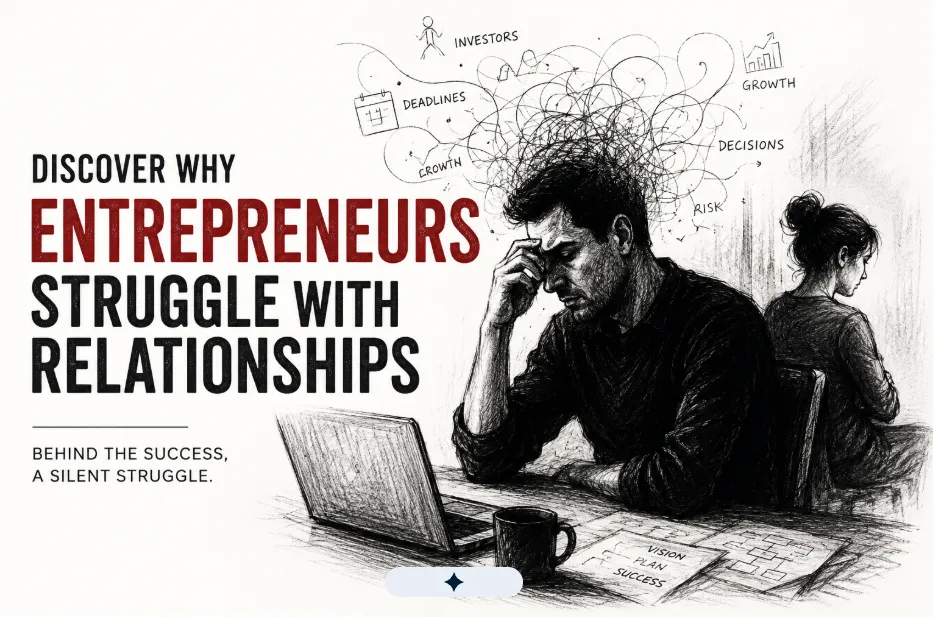

Why Entrepreneurs Struggle With Relationships
Entrepreneurs can struggle with relationships because running a business often involves unpredictable schedules, financial uncertainty, constant decision-making and high mental pressure. Over time, work can reduce emotional availability, personal time and energy for a partner. Other factors such as business identity, control, difficulty with vulnerability and poor recovery can also contribute to relationship difficulties.
- Founder Lifestyle: Entrepreneurship can make relationships difficult when unpredictable work demands leave little room for emotional availability, stability, or personal time.
- Hidden Causes: Identity fusion, depleted emotional bandwidth, control, discomfort with vulnerability, and constant mental pressure can create relationship problems beyond long working hours.
- Lifestyle Compatibility: Strong relationships require realistic expectations around availability, security, family pressures, and the uncertainty that comes with building a business.
- Sustainable Success: Clear communication, defined boundaries, protected relationship time, and better health and energy can help founders pursue ambition without losing connection with their personal lives.
For a founder, building a business can become an all-consuming pursuit. Long hours, unpredictable schedules, constant decisions and the pressure to keep the company moving can slowly affect the relationship waiting at home. You may love your partner deeply and still find yourself emotionally unavailable because the business has taken most of your time, attention and energy.
In this blog, you will explore why entrepreneurs struggle with relationships, what parts of the founder lifestyle can create distance and which deeper patterns keep the problem going. You will also learn how real experiences of founders and couples can reveal what works, how clear communication can create stability and how protecting your health and energy can help you show up better both in business and in your personal life.
Is Your Founder Lifestyle Compatible With A Relationship?
For many founders, relationship difficulties are not simply a result of working long hours. Entrepreneurship can create an unpredictable lifestyle where business decisions, financial uncertainty and constant responsibility compete with the time, attention and energy required for a relationship. Research on entrepreneurs has found that work and family demands can create conflict when the resources required for one role interfere with the other.
Kapil Gupta has repeatedly seen that founders can struggle in relationships even when they genuinely care about their partners. Their business can gradually become the centre of their lifestyle, leaving limited capacity for personal commitments and emotional connection.
The real question is not whether an entrepreneur can have a relationship. It is whether the relationship is compatible with the life the founder is actually living. If the business requires periods of intense work and the founder cannot always be available, both partners need to understand that reality before unrealistic expectations turn into resentment.
Work Comes First
For an entrepreneur, work does not always stop when the working day ends. A founder may leave the office and still be thinking about an employee who resigned, an investor who needs an answer, a client who is unhappy or a business decision that cannot wait until tomorrow. The physical workday may be over, but the mental workday continues.
This can create a difference between what the founder intends and what the partner experiences. The founder may genuinely believe that the sacrifice is necessary because they are building something for the future. The partner may understand that ambition but still feel that they are constantly receiving whatever time is left after the business has taken what it needs.
Over time, this can create resentment. The issue is not always the number of hours spent working. It is the repeated experience of feeling that the relationship can be postponed whenever the business demands attention.
Availability Becomes Rare
A founder can be physically present at home without being emotionally available. They may sit across the dinner table while answering messages, attend a family event while thinking about an upcoming meeting or agree to spend the weekend together while remaining mentally occupied by a business problem.
Research on work-family conflict shows that demands from one area of life can interfere with responsibilities in another. Entrepreneurship can make this boundary particularly difficult because the founder often feels personally responsible for solving problems when they arise.
Kapiil’s approach looks beyond time management and considers the founder’s overall energy and capacity. A person who is chronically stressed, poorly rested or mentally overloaded may technically have time for their partner but lack the emotional capacity to be present during that time.
This is why founders need to look at more than their calendar. They also need to ask whether they have enough energy left to participate in their relationship in a meaningful way.
Some common signs of low availability can include:
- Regularly cancelling personal plans because of work
- Checking business messages during conversations
- Feeling irritated when family needs attention after a difficult workday
- Being physically present but mentally occupied
- Constantly asking the partner to wait until the current business problem is solved
When these behaviours become normal, the partner may stop asking for time altogether. That silence can look like understanding, while actually becoming emotional distance.
Security Feels Uncertain
The question of security becomes even more important when a relationship moves towards marriage or long-term commitment. In India, founders may also face conversations around settling down, financial stability and expectations from both families. A business that is growing rapidly can still feel uncertain from the outside because its income, workload and future direction may change frequently.
A founder may see entrepreneurship as a way of creating a better future. Their partner may agree with that vision but still want stability in the relationship today. The founder may think, “I am building this for our future.” The partner may quietly feel, “But I need you in our present.”
Neither person is necessarily wrong. They may simply have different definitions of security. For one person, security may come from business growth and financial independence. For another, it may come from knowing that plans will be respected, communication will remain consistent and their partner will be emotionally available during difficult periods. This is why founders should discuss what security actually means to both people instead of assuming that financial success will automatically create relationship security.
Lifestyle Matters
Compatibility is often discussed in terms of personality, values and interests. For entrepreneurs, lifestyle compatibility deserves the same attention. A founder may be comfortable with uncertainty, unpredictable schedules and periods where the business requires almost all of their attention. Their partner may want a more predictable life and may find constant changes emotionally exhausting.
This does not mean that one person has to change their personality or that a founder needs to give up their ambition. It means both people need to understand what the relationship will realistically look like.
Before making long-term commitments, founders should be honest about questions such as:
- How much time can I realistically give this relationship?
- What happens when my business enters a difficult phase?
- How will we communicate when I become extremely busy?
- What does my partner need to feel secure?
- Which parts of my lifestyle are unlikely to change?
The important question is therefore not whether entrepreneurs can have successful relationships. Many do. The more useful question is whether the relationship is compatible with the life the founder is actually living.
A successful business should not require a founder to pretend that their lifestyle is something it is not. The healthier approach is to build a relationship around the reality of entrepreneurship rather than around promises that become impossible to maintain.
What Is Really Causing the Relationship Problem?
Business stress can affect a founder’s ability to switch off, recover and be emotionally available at home. Research on entrepreneurs has similarly linked entrepreneurial stressors with difficulty detaching from work, sleep disruption and reduced wellbeing.
This is why the relationship problem cannot always be solved by simply reducing working hours. What matters is also what happens inside the founder during and after those hours. Their identity, stress levels, emotional capacity and constant mental involvement in the business can shape how they communicate and connect with their partner.
Your Business Becomes You
Entrepreneurship often becomes deeply connected to a founder’s identity. The company is not just something they manage. It can become a reflection of their intelligence, ambition, reputation and personal worth. When this happens, a problem in the business can start feeling like a problem with the person.
A poor quarter may therefore feel like personal failure rather than a business setback. A rejected pitch can feel like rejection of the founder. A difficult employee situation can feel like evidence that they are not capable enough to lead. Research on entrepreneurial identity suggests that when the entrepreneurial role becomes highly central to a person’s sense of self, business experiences can have a stronger effect on their personal wellbeing.
This also makes it difficult to switch off at home. If the business is part of who you are, stepping away from it can feel less like taking a break and more like temporarily abandoning an important part of yourself.
Kapiil’s approach is to help founders recognise that their identity needs to be bigger than their performance. A founder can care deeply about the company without allowing every business result to determine how they feel about themselves. When the business becomes the only source of identity and achievement, every setback has the potential to follow the founder into their relationship.
You Have Nothing Left
This is where emotional bandwidth becomes important. Being emotionally available requires more than being physically present. It requires enough mental and physical capacity to listen, respond patiently and engage with another person without feeling overwhelmed.
The partner may see withdrawal, irritation or disinterest. The founder may simply experience exhaustion. This distinction matters because the founder may genuinely care about the relationship while still behaving in ways that create distance. The problem is not necessarily a lack of love. It can be a lack of capacity.
A business owner initially approached Kapiil because of declining energy and poor recovery while also noticing that he had become increasingly irritable and disconnected at home. As his sleep, daily routine and overall health improved, he found himself with greater patience and energy for his family.
You Try To Control Everything
Control can be an important part of building a business. Founders often have to make decisions without having complete information, take responsibility when things go wrong and create systems where there was previously nothing.
The difficulty begins when the same approach is carried into an intimate relationship. A founder may instinctively try to solve every problem, explain every emotion or find an immediate answer whenever their partner expresses dissatisfaction, but relationships do not always require solutions.
Sometimes a partner wants to be heard rather than advised. Sometimes they want their feelings acknowledged rather than analysed. Trying to fix every uncomfortable conversation can make the other person feel that their emotions are being managed instead of understood.
Kapiil’s work with business owners often centres on helping them recognise that constant control comes with a cost. A founder cannot control every business outcome, and they cannot control every personal outcome either. Learning to tolerate uncertainty can therefore be valuable both inside the business and at home.
You Avoid Vulnerability
Founders can become highly comfortable with difficult conversations at work while remaining uncomfortable with emotional conversations at home. They can discuss revenue, hiring, risk and business failure without hesitation but struggle to say that they are scared, overwhelmed or uncertain. This can create emotional distance without either person fully understanding why.
Attachment research provides one possible way of understanding this pattern. Avoidant attachment tendencies, for example, can involve discomfort with emotional dependence or vulnerability. However, attachment style should not be used to label entrepreneurs or assume that founders are naturally avoidant. It is one possible factor that can influence how a person responds to closeness and emotional demands.
For a founder, vulnerability can also feel unfamiliar because the business environment often rewards decisiveness. Being the person who has the answers can become part of their identity. At home, however, constantly being strong can prevent genuine intimacy.
A relationship requires space for conversations that do not have a business solution. Saying “I am worried,” “I do not know what to do,” or “I need your support” can feel uncomfortable, but it can also create a level of connection that achievement cannot provide.
Your Mind Never Stops
Even when the founder is not actively working, their mind may continue running through possible problems and future scenarios. They may be thinking about whether the company has enough cash, whether the next quarter will be strong, whether an important employee might leave or what decision needs to be made tomorrow.
This constant mental load can make rest difficult. It can also make ordinary personal moments feel like interruptions rather than experiences to be enjoyed.
Indian founder research has highlighted the prevalence of emotional and mental wellbeing concerns among entrepreneurs. Rather than relying on an unsupported statistic such as “nearly three in five entrepreneurs have a diagnosed mental health condition,” the article should use a verified figure from the original study and clearly define the population and measure being reported.
The important insight is that the founder’s health and relationship cannot always be treated as separate issues. When the mind is constantly operating under pressure and the body is not recovering properly, the capacity to be patient, attentive and emotionally available can suffer as well.
These five patterns also explain why simply telling a founder to “spend more time with their family” often does not work. The deeper issue may be identity, depleted energy, the need for control, discomfort with vulnerability or an inability to mentally switch off. Until those patterns are recognised, more time alone may not create more connection.
What Kind of Relationship Can This Lifestyle Support?
A founder’s relationship needs to fit the reality of entrepreneurship. Running a business can involve unpredictable schedules, financial uncertainty and periods when work demands significantly more attention. It means both partners need to be honest about what the founder’s lifestyle actually looks like, how much availability is realistic and what each person needs from the relationship. A relationship is more sustainable when expectations are based on reality rather than promises that the founder may not be able to keep.
A Relationship Built on Reality
The first step is accepting what the business actually demands right now. A founder running a stable company may have considerably more flexibility than someone fundraising, entering a new market or trying to keep a struggling business alive. The demands can change as the company moves through different stages.
The mistake is pretending that every phase of entrepreneurship will allow the same amount of personal availability. A founder may promise that they will always have time for their partner because they want to make the relationship work, but repeatedly breaking that promise can create more damage than having an honest conversation about their limitations.
Instead, founders need to recognise their current reality and communicate it clearly. That means acknowledging when the business is entering an intense period and discussing how the relationship can remain connected during that time. This does not mean using entrepreneurship as an excuse to neglect a partner. It means replacing unrealistic promises with realistic commitments.
A Relationship That Feels Secure
Security is not necessarily the same thing for both people in a relationship. A founder may associate security with building wealth, owning a successful company or creating financial independence. Their partner may associate it with emotional consistency, reliability or knowing that important commitments will not always be displaced by work.
This difference can become particularly important when the relationship moves towards marriage. One person may believe that a growing business means the couple is becoming more secure, while the other may feel uncertain because the founder’s time, income or attention remains unpredictable.
Instead of assuming that the partner should understand, founders need to ask what security actually means to them.
A useful conversation can explore:
- What makes you feel secure in this relationship?
- What do you need from me during difficult business periods?
- Which commitments are important enough that work should not routinely replace them?
- What level of financial uncertainty are we both comfortable with?
These conversations can prevent assumptions from turning into resentment.
A Relationship That Is Compatible
Supporting a founder does not simply mean saying, “I support your startup.” The more important question is whether both people are genuinely comfortable with the lifestyle that comes with entrepreneurship.
A partner may admire the founder’s ambition but still struggle with unpredictable schedules. A founder may want complete flexibility while their partner needs more routine. One person may be comfortable taking financial risks while the other may prioritise stability.
These differences do not automatically mean the relationship cannot work. They mean that the couple needs to understand the differences before they become recurring sources of conflict.
Love can help people navigate difficult periods, but love alone does not remove lifestyle incompatibility. Two people can care deeply about each other and still want different ways of living.
For founders, compatibility therefore means asking whether their partner understands the demands of entrepreneurship and whether the founder understands what their partner needs to feel fulfilled in the relationship.
A Relationship Without False Promises
Many relationship problems begin with good intentions. A founder promises to be more available, spend more time at home or stop working on weekends because they want their partner to feel reassured, but if the business reality has not changed, those promises can become difficult to maintain.
Repeatedly saying “I’ll always have time” when you know that you may not be available creates expectations that the relationship cannot sustain.
A more honest conversation could sound like this:
“There will be intense periods in my business when I may not be as available as I want to be. I do not want you to keep guessing where you stand with me. I want us to decide together what we need to protect in our relationship during those periods.”
This approach does not make the founder less committed. It makes the commitment more realistic.
The goal is not to promise that work will never interfere with personal life. That may be impossible for an entrepreneur. The goal is to make sure that both partners understand what those difficult periods will look like and have agreed on how they will handle them.
That is where communication becomes more than a relationship skill. For a founder, it becomes part of building a sustainable life around the business.
What Actually Works When Life Is Unpredictable?
Entrepreneurship does not become predictable just because a founder wants more time for their relationship. There will be periods when the business needs greater attention, and research on entrepreneurial work-life boundaries shows that the lines between work and personal life can become highly permeable.
What makes a relationship sustainable is not having a perfectly balanced schedule. It is having clear expectations about availability, communication and boundaries before pressure builds. Both partners need to understand what they can rely on when the business becomes demanding, so uncertainty does not turn into repeated disappointment.
Build Your Relationship Runway
A business cannot depend entirely on things going according to plan. Founders create systems, processes and contingency plans because they know unexpected problems will happen. The same thinking can be useful in a relationship, without turning the relationship into another business project.
The Relationship Runway Framework is about creating a few expectations that remain protected even when work becomes demanding. The objective is not to create a rigid timetable. It is to create enough consistency that the relationship does not disappear whenever the business becomes difficult.
A founder and their partner can decide in advance what they want to protect:
- Time that remains protected from routine work interruptions
- How often they communicate during particularly demanding periods
- Which work boundaries are important at home
- What qualifies as a genuine business emergency
- How they reconnect after an intense work period
The exact structure will be different for every couple. What matters is that both people know what the relationship can depend on.
For example, a founder may not be able to guarantee that every evening will be free. They may, however, be able to protect certain personal commitments and communicate early when something genuinely unavoidable comes up.
Consistency builds more trust than repeatedly making promises that cannot survive a difficult week.
Have The Hard Conversation
Many founders try to protect their relationships by avoiding difficult conversations. They say they will make more time, work less or be more available without first acknowledging what their business actually demands.
A better approach is to have the conversation before resentment builds.
The founder can begin by explaining the current reality of the business:
“This is what my business looks like right now, and these are the demands it is placing on me.”
The next step is to be honest about capacity:
“This is what I realistically have the capacity to give right now. I do not want to promise something that I cannot consistently deliver.”
The conversation then needs to move towards the partner:
“What do you need from me to feel secure and connected in this relationship?”
From there, both people can identify where their expectations overlap and where they may need to make adjustments. The purpose is not to negotiate every interaction. It is to replace assumptions with clarity.
A founder should also be prepared to hear something uncomfortable. Their partner may not be asking for more money, a bigger home or a more successful business. They may simply want uninterrupted attention, reliability or involvement in important moments.
That information is valuable because it tells the founder what their relationship actually needs rather than what they assume it needs.
Create Family Boundaries
In India, a relationship can involve more than two people. Parents and extended family can have strong opinions about marriage, living arrangements, finances and how much time should be given to family responsibilities. For a founder, these expectations can become difficult to manage alongside the demands of the business.
The answer is not to choose the partner over the family or the family over the partner. It is to make expectations clear before different responsibilities begin competing with each other.
Couples may need to discuss boundaries around:
- How much family involvement they are comfortable with
- Which decisions belong to the couple
- How financial responsibilities will be handled
- How much personal information is shared with family
- How time with different family members will be managed
These conversations can feel uncomfortable, especially in families where expectations have traditionally been understood rather than explicitly discussed, but unclear boundaries can eventually create conflict between partners who may both feel that they are being pulled in different directions.
For founders, this becomes even more important because the business already demands a significant amount of their attention. Without clear personal boundaries, every additional expectation can become another source of pressure.
Can You Build A Successful Business Without Losing Yourself?
Entrepreneurship will always require sacrifice. There will be periods when the business demands more attention, when plans have to change and when the founder has to make difficult choices. Sacrifice itself is not the problem. The problem begins when the founder stops asking what those sacrifices are costing them.
Know What Success Costs
Every founder decides, consciously or otherwise, what they are willing to give up to build the business. In the early stages, that may mean fewer weekends, less free time or more uncertainty, but when the same pattern continues for years, the cost can move into areas that are much harder to recover.
Sleep may be compromised because the mind never switches off. Health may be pushed aside because there is always another business priority. Relationships may receive whatever time and energy remain after everything else has been handled.
This is why founders need to periodically ask themselves what their success is costing them. A business can grow while the person building it becomes increasingly exhausted. From the outside, that may look like success. From the inside, it may feel very different.
The goal is not to eliminate every sacrifice. It is to recognise when the cost has become unsustainable.
Build The Life That You Want
A founder can spend years thinking about how to make the company bigger, more profitable and more valuable. Those questions matter. But they do not describe the whole life the founder is building. At some point, another question becomes equally important: What kind of life am I building around this business?
If the answer is a life where the founder has no energy for their partner, no time for their family and no capacity to enjoy anything outside work, then business growth may not be creating the life they originally wanted.
Kapiil’s philosophy challenges founders to look at success more broadly. The purpose of improving health is not simply to become more productive at work. Better health should give a person greater capacity to participate in their life, whether that means being present with family, enjoying relationships or having the energy to do things that matter to them.
This changes the definition of performance. The question is no longer only how much the founder can achieve. It becomes whether they can achieve it while still having a life they actually want to experience.
Protect The Person Behind The Business
Sleep, recovery, movement, nutrition and stress management may appear unrelated to relationships at first. Yet they influence the energy and emotional capacity a founder brings into everyday interactions. When someone is constantly exhausted, even people they deeply care about may receive very little of their attention.
Founders often want to optimise their businesses first and treat their own health as something they can address later. But the person running the business is also the foundation on which the business operates.
Improving that foundation is not about making a founder less ambitious. It is about making their ambition sustainable. A healthier founder can still build a demanding company. They can still take risks, pursue growth and work towards extraordinary goals. The difference is that their business does not have to consume every part of their life in the process. Ultimately, the goal is not simply to build a successful business. It is to build a successful life alongside it.
Conclusion
Entrepreneurship will always demand time, focus and sacrifice, but your relationship, health and personal life should not become the permanent price of business growth. Building a successful company should also leave you with the energy and capacity to enjoy the life you are working so hard to create.
Kapiil Guptta can help you understand how your lifestyle, stress, sleep and energy are affecting the way you show up in business and at home. With experience working with 1,000+ business owners, Kapiil can help you build a healthier way of operating without asking you to compromise on your ambition.
Frequently Asked Questions
Why do successful people struggle with relationships?
Many of the same traits that contribute to success, such as emotional restraint, decisiveness, and control, can become obstacles in romantic relationships. These qualities are necessary in high-pressure roles but are less effective when it comes to emotional closeness and vulnerability.
What is the 3 6 9 rule for dating?
The 3-6-9 rule for dating is a relationship timeline that guides you to evaluate compatibility at three key milestones: 3 months, 6 months, and 9 months. It helps prevent you from making major commitments during the initial honeymoon phase or staying in a wrong relationship for too long.
How to fix a failing relationship?
Fixing a failing relationship requires establishing emotional safety, practicing deep listening, and taking consistent responsibility for your actions. Most disconnects stem from unaddressed daily neglect or hurt rather than sudden explosions, meaning recovery is a slow process of rebuilding trust through small, calm steps.
Why do high achievers struggle with love?
Many high achievers believe the same formula that brought them professional success will also create emotional fulfillment. Love does not work that way. You cannot earn it through performance. Realizing this can feel confusing and deeply personal.
What are the top 3 reasons why relationships fail?
The main reasons why relationships fail are loss of trust, poor communication, lack of respect, a difference in priorities, and little intimacy. This article discusses why each may cause a relationship to come to an end.
Read More: Why Am I Always Hungry?
Follow Kapiil Gupta on Instagram for practical health tips, executive wellness strategies, and evidence-based guidance to improve your energy, leadership, and business performance.
Instagram: https://instagram.com/kapiilguptta

Leave a Reply