


Family Problems and Mental Health: How to Break the Cycle
Family problems and mental health can be closely connected. Repeated conflict, emotional suppression, control, stress, overwork, and difficulty expressing emotions can create patterns that continue across generations. Understanding how family problems affect mental health can help you recognise unhealthy patterns, set healthier boundaries, and begin breaking the cycle.
Family problems can affect mental health through repeated stress, conflict, emotional suppression, control, poor communication, and learned coping behaviours. When these patterns continue across generations, they may influence how family members handle emotions, relationships, stress, and vulnerability. Breaking the cycle can involve recognising these patterns, setting healthier boundaries, improving communication, regulating emotions, and seeking professional support when needed.
- Generational Trauma: Family patterns can carry forward through learned behaviours, relationship dynamics, stress responses, and potentially biological pathways.
- Recognising the Cycle: Repeated emotional suppression, conflict, control, overwork, people pleasing, or difficulty with vulnerability can signal a family pattern affecting mental wellbeing.
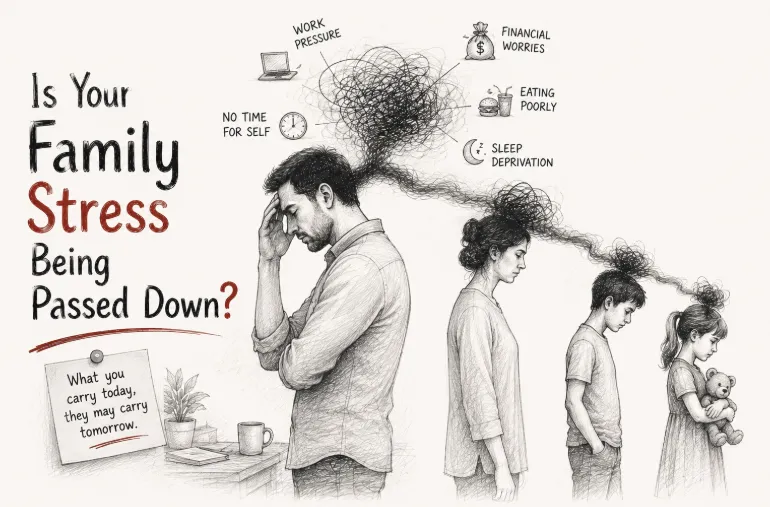
- The Stress Loop: Parental stress can shape a child’s responses, while a child’s distress can increase parental stress, creating a cycle that reinforces itself.
- Breaking the Pattern: Change can begin with one person and grow through healthier boundaries, emotional regulation, supportive relationships, open communication, and professional help when needed.
Family is often where we first learn how to handle emotions, relationships, conflict, stress, and even our understanding of ourselves. But when unresolved stress, difficult experiences, or unhealthy coping patterns continue across generations, they can become part of everyday family life. What one generation experienced can influence how the next generation communicates, reacts, parents, and deals with pressure, often without anyone consciously choosing to repeat the pattern.
In this blog, you will learn what generational trauma is, how family patterns are passed forward, the signs that a cycle may be affecting you, and how stress can move between parents and children. You will also understand the behavioural, psychological, and biological pathways behind these patterns, what individuals and families can do to interrupt them, and what to expect when you become the person who decides to change the cycle.
What Is Generational Trauma?
Generational trauma, also called intergenerational trauma, refers to the ways the effects of severe or prolonged trauma experienced by one generation can influence the emotional wellbeing, behaviour, relationships, and coping patterns of later generations. A child does not need to experience the original traumatic event themselves to be affected by the patterns that develop around it.
For example, a parent who grew up in an environment where emotions were dismissed may learn to suppress their own feelings. They may later respond to their child’s distress in the same way, not because they intend to cause harm, but because this is the way they learned to handle difficult emotions. Over time, these learned responses can become part of the family’s way of communicating and dealing with stress.
Research on intergenerational trauma suggests that the effects of severe adversity can influence subsequent generations through psychological, behavioural, social, and potentially biological pathways. These pathways can include parenting behaviour, family relationships, attachment patterns, learned coping mechanisms, and the way individuals respond to stress.
Through his experience working with more than 1,000 business owners, Kapiil Guptta has seen how patterns that appear unrelated to health can sometimes show up in a person’s relationships and everyday behaviour. Someone may be highly successful at work but struggle to regulate stress at home, communicate openly with their family, or switch off from a constant state of responsibility. In some cases, understanding where these patterns came from becomes an important part of understanding why they continue.
How to Recognize If You’re in a Family Mental Health Cycle
Generational trauma cannot be identified through a checklist or used as a diagnosis. A stronger clue is repetition. When similar emotional or behavioural patterns continue across generations and begin affecting how family members cope, communicate, or relate to each other, it may be worth looking more closely at what the family has learned and carried forward.
Children often learn how to handle emotions by observing caregivers and experiencing repeated interactions at home. A parent who grew up with emotional suppression, anger, constant pressure, or fear may unintentionally pass similar responses to their children.
Common patterns and signs can include:
- Emotional suppression: Feelings are rarely discussed or openly expressed.
- Anger: Stress quickly turns into shouting, criticism, or irritation.
- Avoidance: Difficult conversations are repeatedly postponed.
- Control: Uncertainty leads to controlling behaviour.
- People pleasing: Keeping everyone happy feels like a personal responsibility.
- Money fears: Financial insecurity continues influencing decisions across generations.
- Overwork: Staying busy becomes the main way of dealing with stress.
- Low affection: Love may be present but rarely expressed openly.
- Fear of vulnerability: Asking for help or showing emotions feels uncomfortable.
- Mood monitoring: You constantly watch how others are feeling.
- Conflict anxiety: Even small disagreements make you uncomfortable.
- Boundary guilt: Saying no makes you feel selfish or responsible.
- Repeated behaviour: You notice yourself behaving like the parent you once wanted to be different from.
Research on social learning suggests that children can develop emotional and relational responses through repeated interactions with caregivers. Kapiil Guptta has also seen people who are highly capable professionally can still struggle to switch off, communicate emotionally, or create space for vulnerability at home.
The Difference Between a Difficult Family and a Dysfunctional Cycle
Every family experiences conflict, stress, misunderstandings, and difficult periods. Having arguments or going through a stressful phase does not automatically mean that a family is dysfunctional. The concern is when the same harmful patterns continue, affect relationships, and remain difficult to change even after the original source of stress has passed.
| Difficult Family | Dysfunctional Cycle |
| Conflict may be temporary | The same conflict keeps returning |
| Problems can usually be discussed | Important issues are repeatedly avoided |
| People can repair after conflict | Repair rarely happens |
| Boundaries can be respected | Boundaries are repeatedly challenged |
| Stress affects relationships temporarily | Stress becomes part of family interactions |
| Behaviour can change with circumstances | The pattern continues despite changing circumstances |
The goal is not to label a family as “traumatised.” It is to recognise whether a repeated pattern is affecting relationships and wellbeing. Once the pattern becomes visible, a person can begin asking a more useful question: What do I want to continue, and what do I want to stop with me?
Root Causes Of Trauma Because of Family Problems
Trauma can begin in many different ways. There is no single experience that creates it, and the same family pattern can develop from very different circumstances.
The important part is not only what happened to someone, but what they learned from what happened. A person who grew up feeling unsafe may learn to stay in control. Someone who experienced repeated financial uncertainty may associate constant work with security. Someone who was never allowed to express sadness may learn that emotions should be hidden. These responses can later become part of how they raise their own children or manage relationships.
Some experiences that can shape these patterns include:
- Childhood adversity: Difficult early experiences can influence how safety and relationships are understood.
- Financial insecurity: Repeated money-related stress can create fear around spending, saving, work, or stability.
- Family violence: Exposure to aggression can influence how conflict is handled in later relationships.
- Loss and abandonment: Early experiences of losing important people can affect trust and emotional security.
- Addiction: Growing up around substance misuse can create unpredictability, secrecy, or hypervigilance.
- Displacement: Migration, conflict, or forced relocation can create long-term insecurity within families.
- Parental mental health difficulties: A parent’s struggles can influence the emotional environment in which a child grows up.
- Emotional restriction: Children who are repeatedly told to suppress emotions may learn that vulnerability is unsafe.
An experience can become a family pattern when the response to it is repeated rather than processed. A parent who grew up in an unpredictable home may become highly controlling with their own children because control makes them feel safe. A parent who was taught never to complain may dismiss their child’s distress because they genuinely believe resilience means staying silent. A parent who experienced financial instability may work constantly and unintentionally teach their children that rest is irresponsible.
Kapiil Guptta’s approach is that health cannot be separated completely from the environment in which a person lives. What someone repeatedly experiences as “normal” can influence how they eat, sleep, work, recover, communicate, and respond to stress. This is why understanding a person’s lifestyle sometimes requires looking beyond individual habits and asking what they have learned about stress and wellbeing throughout their life.
The goal is not to blame parents for everything they pass on. Many parents repeat patterns they themselves learned without realising it. Understanding where a pattern came from creates an opportunity to recognise it, question it, and eventually choose a different response for the next generation.
What Is the “Cycle” And How Does It Actually Work?
Family stress can become a cycle when one person’s unresolved emotions begin influencing another person’s behaviour. What starts as parental exhaustion, anxiety, pressure, or emotional difficulty can affect a child’s sense of safety and behaviour. The child’s response can then create additional stress for the parent, making the original problem stronger over time.
The parents’ stress affects the child
A parent living with prolonged stress may become impatient, emotionally unavailable, controlling, withdrawn, or easily triggered. Even when the parent does not intend to hurt the child, repeated reactions can shape how the child understands safety, relationships, and emotional expression. Research on parent-child relationships shows that children’s emotional and behavioural responses can be influenced by the quality of their interactions with caregivers.
Children may respond to this environment differently. Some become quiet and avoid expressing their needs, while others become rebellious or increasingly anxious. Some become highly responsible and start monitoring everyone’s emotions in an attempt to keep the household peaceful. These responses are often adaptations to the environment rather than simply fixed personality traits.
This is something that can become difficult to recognise in high-performing families as well. Through his work with more than 1,000 business owners, Kapiil Guptta has seen how stress that appears manageable professionally can still influence how a person behaves at home. A person may spend years functioning under pressure and begin treating constant responsibility, emotional suppression, or irritability as normal without recognising how their family is experiencing it.
Child’s stress affects the parent
The cycle does not move only from parent to child. A child’s anxiety, withdrawal, anger, academic difficulties, or changes in behaviour can increase parental stress, particularly when the parent is already overwhelmed. The parent may respond by becoming more controlling, critical, punitive, or emotionally distant, which can make the child feel even less understood.
This creates a feedback loop where each person’s response becomes a trigger for the other. The parent sees the child’s behaviour as evidence that stricter control is needed, while the child experiences that increased control as another reason to become anxious, angry, or withdrawn. Research on family systems helps explain how behaviours can influence one another within relationships rather than existing independently.
Kapiil’s approach to health also considers the wider environment in which a person is functioning. If a parent is carrying intense work pressure, poor recovery, or unresolved stress into the home, their capacity to respond calmly can change. Looking at the person’s overall lifestyle can therefore help explain why the same family interaction keeps producing the same response.
How To Stop Generational Trauma
You cannot change what previous generations experienced, but you can change what gets carried forward. Breaking generational trauma means interrupting harmful patterns in the way people respond to stress, communicate, handle conflict, and relate to one another. That change can begin with one person, receive support from relatives, and become stronger when the entire family participates.
Individuals
You can begin by understanding your own patterns instead of waiting for everyone around you to change. Notice what situations trigger strong reactions, where those responses may have come from, and what you tend to do automatically when you feel stressed or unsafe. Emotional regulation, healthier boundaries, reflection, and professional support can help you create a pause between what happens and how you respond.
You can start by:
- Recognising triggers: Notice situations that repeatedly make you angry, anxious, withdrawn, or overwhelmed.
- Questioning beliefs: Examine beliefs such as “I must always be strong” or “rest is irresponsible.”
- Regulating emotions: Learn to calm yourself before reacting to difficult situations.
- Setting boundaries: Communicate what you can and cannot accept without unnecessary guilt.
- Seeking support: Work with a qualified mental health professional when patterns feel difficult to change alone.
You do not need your entire family to change before you can change your own response. Kapiil Guptta’s work with more than 1,000 business owners has shown him how deeply stress responses can become part of everyday behaviour. His approach focuses on helping people understand what their body and behaviour are communicating instead of simply pushing through discomfort.
Relatives
Relatives can make the process easier by becoming part of the person’s support system rather than reinforcing the old pattern. A spouse can give someone space to process emotions instead of immediately demanding an explanation. A sibling can listen without turning the conversation into blame. Parents can acknowledge when their own reactions may have contributed to a difficult dynamic.
Relatives can help by:
- Listening without judging: Allow the person to explain what they are experiencing.
- Respecting boundaries: Give them space when they need it without treating it as rejection.
- Avoiding old triggers: Recognise behaviours that repeatedly escalate conflict.
- Encouraging support: Help them access therapy or other appropriate professional care.
- Repairing after conflict: Come back to the conversation instead of letting resentment build.
The goal is not for relatives to become therapists. It is to create relationships where healthier responses are supported rather than punished. When one person starts changing, familiar family dynamics may initially feel uncomfortable because everyone has become accustomed to the old pattern.
Family as a whole
To address generational trauma at its core, the family has to change the environment in which these patterns are learned. This means creating new expectations around communication, emotions, conflict, and support. If previous generations survived by staying silent, the next generation can learn that difficult conversations are allowed. If vulnerability was treated as weakness, the family can begin treating emotional honesty as part of a healthy relationship.
A family can begin creating new norms by:
- Talking openly: Make space for difficult subjects instead of avoiding them.
- Allowing emotions: Let family members express feelings without immediately dismissing them.
- Changing conflict: Replace shouting, silence, or punishment with calmer communication.
- Respecting boundaries: Accept that family members can have different needs and opinions.
- Repairing harm: Encourage apologies, accountability, and conversations after conflict.
- Getting professional help: Consider family therapy or individual mental health support when patterns are deeply established.
This is where breaking the cycle becomes more than an individual exercise. A healthier family does not mean a family without conflict. It means a family that has learned different ways to handle conflict. The aim is to ensure that children do not simply inherit the coping mechanisms their parents needed to survive difficult circumstances, but have the opportunity to develop healthier ways of living, connecting, and responding to stress.
What to Expect When You Become a Cycle Breaker
Breaking a family pattern can be meaningful, but it is not always comfortable. When you begin questioning behaviours that have existed for years, the change can affect your relationships, your sense of identity, and your understanding of your childhood. You may experience relief, but you may also experience resistance, loneliness, guilt, or grief.
The Loneliness of Being the First
The first person to question a family pattern can feel isolated because everyone else may be comfortable with what has always been considered normal. You may be the person who says, “We don’t have to speak to each other this way,” “We can talk about this,” or “I don’t want my children to experience what I experienced.” Even when the intention is to create something healthier, changing a familiar dynamic can make other people uncomfortable.
You may notice that:
- Old patterns feel normal: Others may not understand why you want something different.
- Conversations feel uncomfortable: Speaking openly can initially create tension.
- You question yourself: You may wonder whether you are overreacting.
- Change feels exhausting: Constantly responding differently requires awareness and effort.
Kapiil Guptta’s work with more than 1,000 business owners has shown him that changing deeply established patterns often requires more than simply knowing what should change. A person may understand that stress, emotional suppression, or overwork is affecting their life and still find it difficult to respond differently in the moment.
Your Family Calling You the Problem
Changing your role within a family can create resistance. Someone who previously stayed silent may suddenly be called difficult when they begin expressing boundaries. Someone who stops participating in repeated arguments may be called selfish. When one person stops responding in the familiar way, other family members may not immediately know how to respond.
This can look like:
- Being called difficult: Speaking up may be treated as creating unnecessary conflict.
- Being called selfish: Setting boundaries may be interpreted as rejecting the family.
- Facing resistance: Relatives may prefer the familiar pattern.
- Feeling guilty: You may question whether protecting your wellbeing is hurting others.
However, not every criticism means you are successfully breaking a cycle. Healthy cycle breaking also requires self-reflection. A boundary should not become an excuse to avoid accountability, and recognising family patterns should not mean blaming everyone else for your behaviour. When the situation feels complicated, professional guidance can help distinguish healthy boundary-setting from avoidance or blame.
The Grief of Seeing Your Parents as Victims Too
One of the hardest parts of understanding generational trauma can be seeing your parents differently. You may begin to realise that the parent who was emotionally distant, controlling, angry, or unable to communicate may have also grown up carrying experiences they never understood. This can bring compassion, sadness, and grief at the same time.
You may begin asking questions such as:
- What did they experience?
- What did they never learn?
- What were they trying to protect themselves from?
- What did they unknowingly pass forward?
Understanding your parents’ history can create compassion, but compassion does not require excusing harmful behaviour. You can understand why someone behaved a certain way while still recognising that their behaviour affected you. This distinction is essential when breaking a family pattern because forgiveness, reconciliation, or continued closeness are not prerequisites for change.
Understanding where a pattern came from does not mean you have to continue it. Sometimes becoming a cycle breaker means accepting that your family did the best it could with what it knew, while also deciding that you want to learn something different.
Conclusion
Breaking a generational pattern does not mean changing your entire family overnight. It starts with recognising what has been repeated, understanding where it came from, and choosing a healthier response. You cannot change the past, but you can influence what gets carried forward.
Kapiil can help you understand how stress, emotional patterns, and everyday habits may be affecting your wellbeing and relationships. With experience working with 1,000+ business owners, his approach focuses on helping people build healthier patterns that can extend beyond themselves.
Frequently Asked Questions
How can I break dysfunctional family patterns?
Breaking the cycle of family dysfunction means identifying toxic generational patterns, setting firm personal boundaries, and choosing new, healthy behaviors. This difficult journey often involves facing resistance or misunderstanding from relatives as you disrupt long-standing family habits.
How to deal with family problems?
Dealing with family problems requires staying calm, setting clear boundaries, and practicing active listening. Separate the issue from the person, avoid personal attacks, and look for compromises. If problems persist or become toxic, create healthy distance or seek guidance from a professional family counselor.
How to leave a dysfunctional family?
Leaving a dysfunctional family involves planning a safe exit, setting firm boundaries, and building a new support system. Most people find success through physical relocation, quiet disengagement, and seeking outside help.
Why is there so much mental illness in my family?
Certain factors may increase your risk of developing a mental illness, including: A history of mental illness in a blood relative, such as a parent or sibling. Stressful life situations, such as financial problems, a loved one’s death or a divorce. An ongoing (chronic) medical condition, such as diabetes.
How to handle a toxic family?
To deal with toxic family members, set firm personal boundaries, limit contact or communication, detach emotionally from their behavior, and prioritize your own mental health over keeping the peace. You do not have to accept abuse or manipulation just because you share DNA.
How to heal family issues?
Seek Professional Guidance: Engage with a family counselor who can offer tailored strategies for your family’s needs. 3. Practice Mindful Communication: Work on expressing yourself clearly and listening actively to others.
Read More: The Truth About Intermittent Fasting for Indians
Follow Kapiil Gupta on Instagram for practical health tips, executive wellness strategies, and evidence-based guidance to improve your energy, leadership, and business performance.
Instagram: https://instagram.com/kapiilguptta

Leave a Reply