

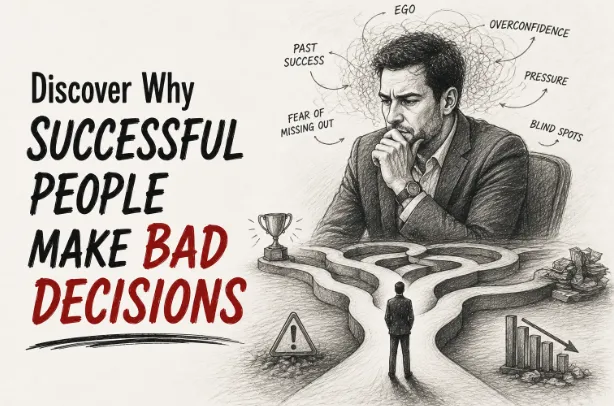

Decision Fatigue: Why Successful People Make Bad Decisions
- Decision Fatigue Explained: Decision fatigue occurs when repeated choices drain your mental energy, making it harder to think clearly, stay focused, and make sound decisions, even if you are not physically tired.
- Recognising the Hidden Signs: Constant procrastination, overthinking, impulsive decisions, mental exhaustion, and avoiding important conversations are often signs of cognitive overload rather than poor discipline or lack of motivation.
- How High Performers Protect Their Thinking: Successful leaders preserve their decision-making capacity by simplifying routine choices, scheduling important decisions during peak mental hours, delegating decision ownership, and relying on systems instead of constant willpower.
- Protecting Mental Energy Every Day: Better sleep, structured routines, fewer unnecessary decisions, and healthy daily systems help reduce cognitive load, allowing you to focus your mental energy on the choices that have the greatest long-term impact.
Every day, you make hundreds of decisions without even realizing it. Some are important, like hiring an employee or planning your finances. Others seem insignificant, like choosing what to eat, replying to a message, or deciding which email to answer first. While each decision feels small on its own, together they place a constant demand on your brain. By the end of the day, even simple choices can feel surprisingly difficult.
Many people mistake this mental exhaustion for laziness, poor discipline, or a lack of motivation. In reality, the problem is often decision fatigue. Having worked with more than 1,000 business owners, Kapiil Guptta has seen how constant decision-making quietly affects productivity, health, and overall performance. In this blog, you’ll learn what decision fatigue is, how to recognise its signs, why it leads to poor decisions, and the practical strategies successful people use to protect their mental energy every day.
What Is Decision Fatigue?
Decision fatigue is the gradual decline in your ability to make good decisions after making too many choices over a period of time. Every decision, whether it is approving a proposal, choosing what to wear, responding to a message, or deciding whether to work out, consumes a small amount of mental energy. Individually, these decisions may seem insignificant. Together, they place a significant demand on your brain.
Over the years, Kapiil Guptta has worked with more than 1,000 business owners and senior professionals. One pattern appears repeatedly. The people who struggle with decision fatigue are not always the ones working the longest hours. They are often the ones making the greatest number of decisions. Their days are filled with choices that affect employees, finances, clients, family, and their own health. By the time they finally have a moment for themselves, their ability to think clearly has already declined.
Understanding how this happens is the first step towards protecting your mental energy.
The Science Behind Decision Fatigue
Your brain is designed to make decisions, but it is not designed to make an unlimited number of them. Most of your decision-making happens in the prefrontal cortex, the part of the brain responsible for planning, reasoning, problem-solving, and self-control. Every time you weigh options, resist temptation, or analyse information, this region becomes active. Just like a muscle becomes tired after repeated use, your brain’s executive functions become less efficient after continuous decision-making.
Researchers have found that decision-making relies on a limited pool of cognitive resources. As these resources are used throughout the day, your brain begins looking for ways to conserve energy. Instead of carefully evaluating every option, it starts relying on shortcuts. This is why you may choose convenience over quality, postpone important decisions, become impulsive, or simply avoid making choices altogether. The issue is not intelligence. It is reduced mental capacity caused by repeated cognitive effort.
It is also important to understand that decision fatigue is different from physical tiredness. You may have slept well and still struggle to make simple choices if your brain has been processing information continuously. Many business owners tell Kapiil Guptta that they feel mentally exhausted even on days when they have barely moved physically. Once they begin reducing unnecessary decisions and improving their daily routines, they often notice that their clarity returns long before their workload changes.
Signs You Are Experiencing Decision Fatigue
Decision fatigue builds quietly throughout the day until even the simplest decisions begin to feel difficult. Many people mistake these signs for laziness, poor discipline, or a lack of motivation. In reality, they are often indicators that your brain has reached its decision-making limit.
Kapiil Guptta has observed that many business owners don’t realise they’re experiencing decision fatigue because they’re still working. They continue attending meetings, replying to emails, and solving problems. What changes is the quality of their thinking. They begin delaying important conversations, making rushed choices, or avoiding decisions altogether. Recognising these signs early can help you recover before your performance begins to suffer.
Kapiil Guptta frequently notices these patterns among business owners who initially believe they have lost motivation. Once they begin protecting their mental energy, these behaviours often reduce without any productivity hacks or motivational techniques.
- You keep delaying simple decisions.
- You overthink choices that should be straightforward.
- You choose convenience over long-term benefits.
- You feel mentally exhausted despite little physical activity.
- You make impulsive decisions.
- You procrastinate even when you know what needs to be done.
- You avoid important conversations or commitments.
- Small questions or interruptions irritate you.
- You continue following ineffective routines because they feel familiar.
Decision Fatigue vs. Decision Paralysis vs. Burnout
These three terms are often used interchangeably, but they describe very different challenges. Understanding the difference is important because each one has a different cause and requires a different solution. Treating decision fatigue like burnout or assuming decision paralysis is simply a lack of confidence can delay recovery and make the problem worse.
Decision fatigue happens when your brain has spent too much mental energy making choices throughout the day. As your cognitive resources decline, the quality of your decisions declines as well. You may make impulsive choices, delay important decisions, or simply choose the easiest option. The good news is that decision fatigue is often temporary. Better sleep, fewer unnecessary decisions, structured routines, and regular recovery can restore your mental clarity.
Decision paralysis is different. Here, the problem is not a lack of mental energy but difficulty committing to a choice. Fear of making the wrong decision, perfectionism, or uncertainty prevents action. Even when your mind is fresh, you may continue analysing every possibility without moving forward. In these situations, building confidence, accepting uncertainty, and simplifying choices are often more helpful than rest alone.
Burnout develops over a much longer period. It results from prolonged stress, emotional overload, and inadequate recovery. Unlike decision fatigue, burnout affects motivation, emotional well-being, and overall functioning. A weekend off rarely solves burnout because the underlying lifestyle and work patterns remain unchanged. Kapiil Guptta has worked with many business owners who believed they were burnt out when they were actually experiencing severe decision fatigue. Once unnecessary decisions were reduced and healthier daily systems were introduced, many regained their focus and energy much faster than expected.
| Decision Fatigue | Decision Paralysis | Burnout |
| Mental energy is depleted after making many decisions | Fear or uncertainty prevents action | Long-term emotional, mental, and physical exhaustion |
| Results in poor or impulsive decisions | Results in no decision at all | Results in loss of motivation and disengagement |
| Usually develops within a day | Can occur before making a decision | Develops over weeks or months of chronic stress |
| Improves with rest, routines, and reducing decision load | Improves with clarity, confidence, and simpler choices | Requires recovery, lifestyle changes, and stress management |
Confusing these conditions often leads people to choose the wrong solution. Someone with decision fatigue may believe they need more motivation when they actually need fewer decisions. A person experiencing decision paralysis may keep taking breaks instead of addressing the fear that prevents action. Someone dealing with burnout may try productivity techniques when what they really need is long-term recovery. Identifying the real problem is the first step toward finding the right solution.
Why Do You Make Bad Decisions?
Most people assume they make poor decisions because they lack discipline or don’t think things through. In reality, decision quality often declines because the brain simply has fewer mental resources available. When your cognitive energy is low, your brain stops optimising for the best outcome and starts optimising for the easiest one. This shift affects everything from business decisions to food choices, financial planning, and personal relationships.
Kapiil Guptta has seen this pattern repeatedly while coaching business owners. Many clients initially believed they had become indecisive or less capable. However, after reducing unnecessary decisions and improving their daily routines, they found themselves making clearer and more confident decisions without changing their intelligence or experience. The difference was not knowledge. It was the amount of mental energy available to use that knowledge effectively.
Your Brain Can’t Think As Clearly
Decision fatigue directly affects your cognitive performance. As your brain processes hundreds of decisions throughout the day, it becomes harder to maintain attention, remember information, and think logically. You may find yourself rereading the same email several times, forgetting what was discussed in a meeting, or struggling to organise your thoughts during an important conversation. These are signs that your cognitive resources are becoming depleted.
When this happens, your brain begins relying on mental shortcuts instead of careful analysis. Rather than weighing all the available information, it looks for the quickest path to a decision. This increases the likelihood of confirmation bias, impulsive judgments, and emotionally driven choices. Instead of asking, “What is the best option?” your brain quietly asks, “What requires the least effort?”
Kapiil Guptta often notices this among entrepreneurs making business decisions late in the evening. A conversation that would have been handled calmly in the morning suddenly feels overwhelming, or a strategic decision is postponed because thinking it through feels mentally exhausting. The problem is rarely capability. It is temporary cognitive fatigue affecting the quality of thinking.
How cognitive performance changes during decision fatigue
- Reduced attention and concentration.
- Lower working memory, making it harder to retain information.
- Less logical reasoning during complex decisions.
- Greater reliance on cognitive shortcuts.
- Increased emotional decision-making instead of objective thinking.
Your Mental Energy Gets Limited
Your mental energy works much like a daily budget. Every decision you make, whether important or trivial, spends a small portion of that budget. By the time you reach decisions that genuinely matter, your brain may already have used much of its available capacity. This is why successful people often simplify everyday choices. They are not avoiding decisions. They are protecting their mental resources for the decisions with the greatest impact.
Research suggests that self-control and decision-making rely on many of the same cognitive systems. As your ability to regulate attention and resist distractions declines, your ability to evaluate options also becomes weaker. This is why resisting unhealthy food, concentrating on difficult work, and making thoughtful business decisions often become harder at the same time.
Kapiil Guptta encourages business owners to audit the decisions they make every day. Many discover they are spending valuable mental energy on repetitive choices that could easily become routines or systems. Removing even a handful of unnecessary decisions often creates more mental space for creative thinking and better leadership.
Ways unnecessary decisions drain your mental energy
- Deciding what to wear every morning.
- Constantly checking notifications.
- Repeatedly switching between tasks.
- Making last-minute food choices.
- Responding to every message immediately.
- Re-evaluating decisions that have already been made.
Your Brain Starts Choosing Comfort Over Strategy
When mental energy runs low, your brain naturally shifts from long-term thinking to immediate relief. Instead of focusing on future benefits, it begins prioritising choices that reduce effort in the present moment. This is why people often skip workouts, postpone important conversations, or choose entertainment over meaningful work after a mentally demanding day.
This shift also changes your willingness to take risks. Some people become impulsive and make quick decisions without gathering enough information. Others become overly cautious and delay action because every option feels mentally overwhelming. Both responses are attempts by the brain to conserve energy rather than carefully evaluate the situation.
Kapiil Guptta frequently reminds clients that these behaviours are not personality traits. They are often temporary responses to mental fatigue. Once the brain has recovered through better sleep, structured routines, movement, and fewer unnecessary decisions, strategic thinking becomes much easier.
Common survival-mode behaviours
- Choosing immediate rewards over long-term goals.
- Avoiding difficult conversations or challenging work.
- Preferring familiar routines even when they are ineffective.
- Becoming either impulsive or excessively cautious.
- Focusing on relief instead of long-term outcomes.
AI Can Also Create Decision Fatigue
Artificial intelligence has the potential to reduce decision fatigue, but only when it is used intentionally. AI can automate repetitive work, summarise long documents, organise information, generate first drafts, and reduce the time spent on routine tasks. By removing low-value decisions, it allows you to spend more mental energy on strategic thinking and creative problem-solving.
At the same time, AI can also contribute to decision fatigue if it creates more options than you actually need. Multiple content drafts, dozens of recommendations, endless prompts, and competing suggestions still require evaluation. Instead of making one decision, you may find yourself comparing ten different possibilities. This can increase over-analysis and create another layer of cognitive load.
Kapiil Guptta encourages business owners to think of AI as a tool for reducing repetitive decisions, not replacing human judgment. The most valuable business decisions still require experience, context, emotional intelligence, and critical thinking. AI should help clear mental space for those decisions rather than filling it with even more choices.
What Successful People Actually Do
The world’s highest performers are not successful because they make more decisions than everyone else. They are successful because they protect their ability to make good decisions. Instead of spending mental energy on trivial choices, they build routines, systems, and habits that reduce unnecessary thinking. This allows them to reserve their cognitive energy for the decisions that truly influence their business, health, and relationships.
Kapiil Guptta has noticed a similar pattern among business owners who consistently perform at a high level. They don’t rely on motivation every morning. They reduce the number of decisions they need to make, create predictable routines, and focus their mental energy on high-impact work. Decision management, rather than time management, often becomes the difference between feeling overwhelmed and staying consistently productive.
Simplify The Decisions That Don’t Matter
Some of the world’s most recognised leaders are known for wearing almost the same outfit every day. Steve Jobs wore his signature black turtleneck, Mark Zuckerberg often chose a grey T-shirt, and Barack Obama has spoken about limiting routine choices so he could focus on more important decisions. The goal was never fashion. It was preserving mental energy for leadership.
The same principle applies beyond clothing. Successful people create routines for recurring decisions like breakfast, workouts, commuting, or planning their day. When everyday choices become automatic, the brain spends less energy deciding and more energy solving meaningful problems. These systems remove unnecessary cognitive load without reducing productivity.
Kapiil Guptta often encourages business owners to identify the decisions they make repeatedly and turn them into routines. Standardising even a few daily choices can create noticeable improvements in focus, especially during busy weeks.
Ways to reduce trivial decisions
- Follow a consistent morning routine.
- Plan meals in advance.
- Keep a simple wardrobe for workdays.
- Schedule recurring activities at fixed times.
- Create checklists for repetitive tasks.
Make Your Biggest Decisions When Your Brain Is Fresh
Not every hour of the day offers the same quality of thinking. Your brain has the highest levels of focus and mental energy earlier in the day, especially after adequate sleep and before decision fatigue begins to build. This is why many successful leaders reserve their mornings for strategic work instead of filling them with meetings and emails.
High-impact work such as financial planning, hiring decisions, creative thinking, and business strategy often benefits from being scheduled during your peak mental hours. Administrative work, routine meetings, and reviews can usually be handled later in the day when your cognitive energy naturally begins to decline. Even evenings can be reserved for reflection, planning the next day, and personal decisions that don’t require intense mental effort.
Kapiil Guptta frequently recommends that business owners stop allowing their inbox to determine their priorities. Instead, schedule your most important thinking before the day’s distractions begin competing for your attention.
A simple decision schedule
- Morning: Strategy, hiring, financial planning, creative work.
- Afternoon: Meetings, reviews, administrative tasks.
- Evening: Planning tomorrow, reflection, personal decisions.
Delegate Decisions
Many leaders believe delegation simply means assigning work to someone else. In reality, true delegation means transferring the authority to make appropriate decisions within clear boundaries. If every small decision still comes back to the business owner for approval, the workload may decrease, but decision fatigue remains exactly the same.
Successful organisations define who owns specific decisions, when issues should be escalated, and which situations require leadership involvement. This creates autonomous teams that can solve routine problems independently while allowing leaders to focus on decisions that genuinely require their expertise.
Kapiil Guptta has worked with several founders who believed they needed to be involved in every detail of their business. Once they established clear decision ownership and trusted their teams with recurring decisions, they experienced not only reduced mental fatigue but also faster business operations.
Effective delegation includes
- Defining decision ownership.
- Setting approval limits.
- Creating clear escalation rules.
- Building systems that reduce dependency on the founder.
- Empowering teams to solve routine problems independently.
Don’t Wait For Perfect Certainty
Jeff Bezos popularised the idea that many business decisions should be made when you have around 70 percent of the information rather than waiting for complete certainty. Waiting until every possible question has been answered often delays progress and creates missed opportunities. In fast-moving environments, learning through action is often more valuable than endless analysis.
This doesn’t mean making careless decisions. It means recognising that some choices can be adjusted later. Launching a new marketing campaign, testing a pricing strategy, or introducing a product improvement often provides more valuable insights through execution than through months of planning. Successful leaders understand which decisions are reversible and which require deeper analysis.
Kapiil Guptta often reminds business owners that perfection is rarely the goal. Progress comes from making thoughtful decisions, observing the results, and refining the approach over time instead of waiting for absolute certainty that may never arrive.
The 70% Rule in practice
- Gather enough information to make an informed decision.
- Avoid delaying action while seeking perfect certainty.
- Test ideas on a small scale where possible.
- Learn from feedback and adjust quickly.
- Reserve detailed analysis for irreversible decisions.
Create Parts Of Your Day Where No Decisions Are Required
One of the simplest ways to reduce decision fatigue is to remove decisions altogether. Decision-free zones are parts of your day where routines replace constant choices. Instead of deciding what to eat, when to exercise, or how to organise your work every morning, these activities follow a predefined plan.
Simple habits such as eating a fixed breakfast, following a planned workout schedule, batching meetings on specific days, preparing meals in advance, and checking emails during fixed time blocks reduce the number of decisions your brain must make. Automation can further reduce mental effort by handling recurring payments, reminders, and repetitive administrative tasks.
Kapiil Guptta has found that clients who build structured routines often report feeling calmer and more focused within a few weeks. Their workload may remain the same, but because they spend less energy on everyday decisions, they have greater mental capacity for the challenges that actually matter.
Ideas for decision-free zones
- Fixed morning routine.
- A consistent breakfast on workdays.
- Pre-planned workout schedule.
- Theme days for similar tasks.
- Scheduled email windows.
- Batch meetings together.
- Weekly meal preparation.
- Automate recurring payments and reminders.
How To Reduce Decision Fatigue Every Day
You cannot eliminate decisions from your life, but you can reduce the number of unnecessary ones. The goal is not to become more disciplined. It is to protect your mental energy so you can make better decisions when they matter most. Small changes in your daily routine can significantly reduce cognitive load and improve your ability to think clearly throughout the day.
Kapiil Guptta often tells business owners that productivity is not about squeezing more work into the day. It is about ensuring your brain has enough energy left for the conversations, strategies, and decisions that have the greatest impact. The following practices are simple to implement, yet they can make a noticeable difference in how you feel and perform.
Prioritize The Decisions That Shape Your Future
Not every decision deserves the same amount of attention. Many people spend more time deciding what to watch in the evening than planning their health, finances, or long-term career. When your mental energy is limited, it should be reserved for decisions that influence your future rather than choices that have little lasting impact.
Your health, career, relationships, and finances are areas where thoughtful decisions create long-term benefits. On the other hand, spending excessive time comparing products online, repeatedly changing your schedule, or debating minor daily choices often provides very little value. Learning to recognise the difference helps you preserve mental energy for what truly matters.
Kapiil Guptta encourages clients to ask one simple question before investing time in a decision: “Will this matter a month from now?” If the answer is no, simplify it, automate it, or make the decision quickly so your brain remains available for higher-value thinking.
Focus your mental energy on
- Health and daily well-being.
- Career and business growth.
- Meaningful relationships.
- Financial planning and investments.
Spend less energy on
- Minor purchases.
- Repetitive daily choices.
- Constant comparison between similar options.
- Decisions with little long-term impact.
Build Systems So You Don’t Depend On Motivation
Willpower is unpredictable. Some days you feel motivated, while on others even simple tasks seem difficult. Systems remove this uncertainty by making good decisions easier to repeat. Instead of deciding what to do every day, you follow a process that has already been planned.
Simple systems such as habit stacking, daily checklists, reusable templates, and standard operating procedures reduce the number of decisions required throughout the day. Automation can handle recurring tasks like bill payments, reminders, and calendar scheduling, while default choices remove the need to repeatedly decide the same thing. The less often your brain has to revisit routine decisions, the more energy it saves for meaningful work.
Kapiil Guptta has found that business owners who rely on systems experience less mental fatigue than those who rely solely on discipline. Success becomes more consistent because their routines continue working even on days when motivation is low.
Systems that reduce decision fatigue
- Habit stacking to make routines automatic.
- Daily checklists for recurring tasks.
- Templates for emails and meetings.
- Automation for repetitive work.
- Default choices for meals or schedules.
- Standard operating procedures for business processes.
Take Care Of The Brain That Makes Your Decisions
Your decision-making ability depends on your physical health as much as your mental skills. A sleep-deprived, dehydrated, or poorly nourished brain cannot consistently make thoughtful decisions, regardless of experience or intelligence. Many people try to improve productivity while ignoring the biological factors that support cognitive performance.
Good sleep restores attention and memory, balanced nutrition provides a steady supply of energy, and proper hydration supports concentration throughout the day. Regular movement improves blood flow to the brain, while short breaks prevent mental exhaustion from building continuously. Practices such as meditation and deep work also help by reducing distractions and allowing your brain to recover from constant stimulation.
Kapiil Guptta frequently reminds clients that their brain is the most valuable business asset they own. Investing in sleep, movement, and recovery is not a luxury. It is a strategy for making better decisions every single day.
Protect your cognitive energy by
- Getting sufficient, high-quality sleep.
- Eating balanced meals at regular times.
- Staying adequately hydrated.
- Exercising consistently.
- Taking short breaks between focused work.
- Practising meditation or mindful breathing.
- Scheduling uninterrupted deep work sessions.
Reduce The Number Of Decisions You Make Each Day
One of the most effective ways to reduce decision fatigue is simply to make fewer decisions. Every unnecessary choice consumes mental energy that could be used elsewhere. By simplifying your day and grouping similar activities together, you can significantly reduce the cognitive effort required to stay productive.
Batching similar tasks, limiting notifications, setting time limits for routine decisions, and creating fixed routines all reduce the number of times your brain has to switch attention. Instead of deciding the same thing repeatedly, make recurring decisions once and follow them consistently. Small adjustments like these often create more mental clarity than complicated productivity systems.
Kapiil Guptta has seen many business owners regain focus not by working less, but by reducing the constant stream of small decisions competing for their attention. Protecting your mental energy begins with simplifying your day before trying to optimize it.
Practical ways to reduce daily decisions
- Batch similar tasks together.
- Turn off unnecessary notifications.
- Set time limits for low-impact decisions.
- Make recurring decisions once instead of every day.
- Follow consistent routines whenever possible.
- Avoid switching constantly between unrelated tasks.
- Review your schedule before the day begins instead of reacting throughout the day.
Conclusion
Decision fatigue is not a sign that you are incapable or unmotivated. It is a sign that your brain has been working harder than you realise. By reducing unnecessary decisions, creating better systems, and protecting your mental energy, you can make clearer choices and perform at your best every day.
The goal is not to make more decisions. It is to make fewer, better ones. When you stop spending mental energy on things that don’t matter, you create space for the decisions that improve your health, strengthen your relationships, and grow your business.
If you constantly feel mentally exhausted, struggle to focus, or find yourself making decisions you later regret, it may be time to look beyond productivity hacks. Having worked with more than 1,000 business owners, Kapiil Guptta helps leaders identify the hidden factors affecting their energy, decision-making, and performance. Through personalised health and lifestyle strategies, he helps you build the physical and mental foundation needed to make better decisions consistently.
Frequently Asked Questions
Why do I get such bad decision fatigue?
Decision fatigue and burnout are related but distinct challenges. Decision fatigue occurs when a person faces too many choices, leading to mental fatigue, brain fog, and decision avoidance, which makes focusing on important decisions difficult. It drains mental energy and can result in stress.
Do people make bad decisions when tired?
Decision fatigue can cause us to make poor decisions. As we reach mental exhaustion, our brains take illogical shortcuts to aid us in our decision-making. These shortcuts often result in reduced self-control, impulsivity, and reliance on biases, impairing our ability to evaluate long-term outcomes effectively.
Why do people make such bad decisions?
Poor decisions happen when strong emotions, mental shortcuts, or high stress override logical long-term thinking. When our brains are tired or overwhelmed, we tend to choose quick relief or easy fixes instead of carefully weighing the future results.
Is decision fatigue an ADHD thing?
Yes, severe decision fatigue is closely linked to ADHD. While anyone can feel tired from making choices, people with ADHD experience a much faster drain on their mental energy. This happens because executive dysfunction makes tasks like planning, prioritizing, and weighing options far more taxing on the brain.
How to defeat decision fatigue?
To overcome decision fatigue, you can streamline your daily choices by establishing routines, setting default options, and prioritizing important tasks early in the day.
👉 Read More: Best Morning Routine for Entrepreneurs
Follow Kapiil Gupta on Instagram for practical health tips, executive wellness strategies, and evidence-based guidance to improve your energy, leadership, and business performance.
👉 Instagram: https://instagram.com/kapiilguptta

Leave a Reply