

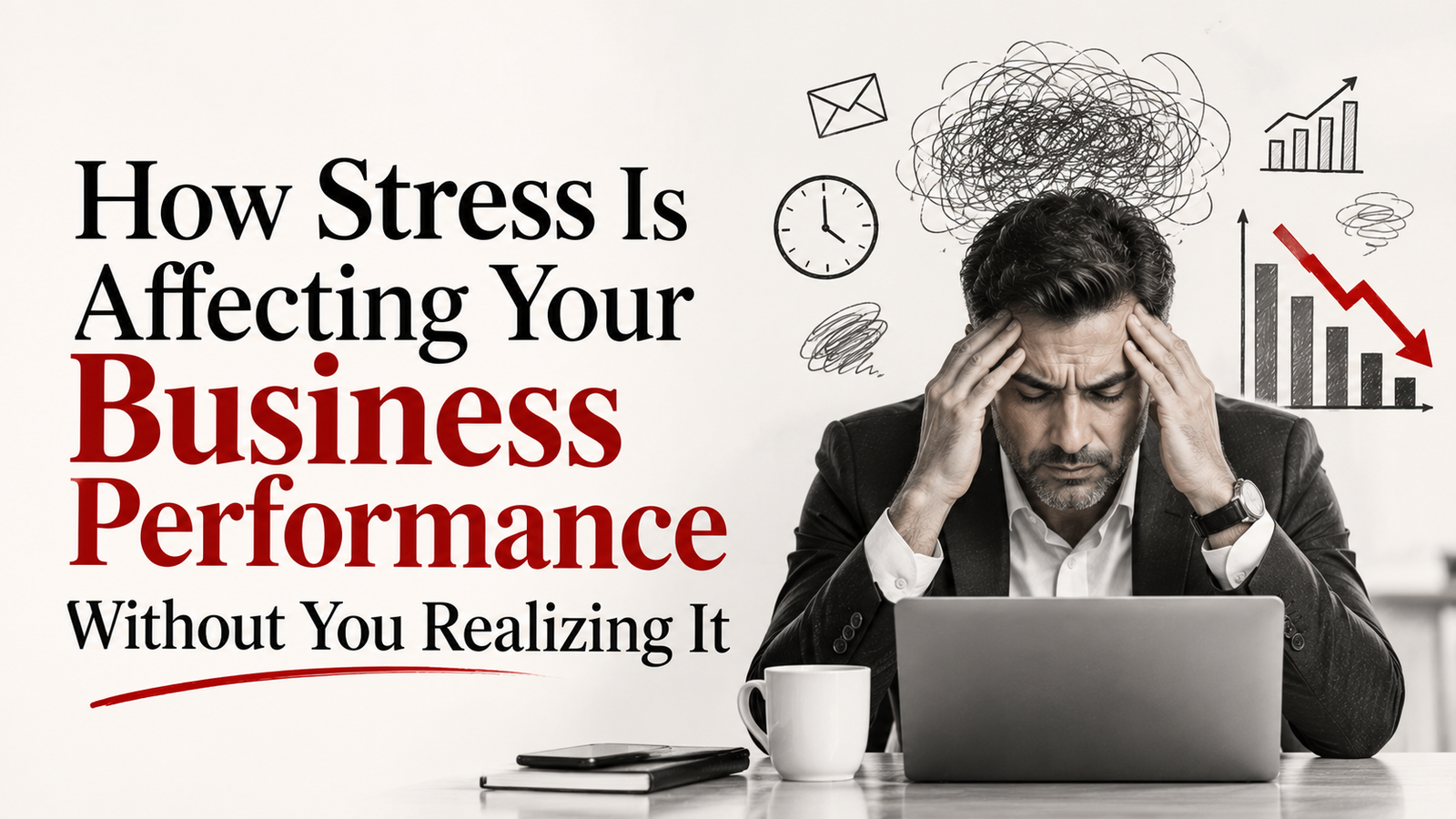

How Stress Is Affecting Your Business Performance Without You Realizing It
Understanding how stress affects business performance is important for business owners who regularly deal with financial pressure, long working hours, team responsibilities, and constant decision-making. Prolonged stress can influence your health, productivity, leadership, and ability to make effective business decisions.
Stress can be an unavoidable part of running a business, long working hours, financial responsibilities, employee management, and the pressure to keep growing can gradually affect your sleep, energy, concentration, and emotional well-being. What may begin as occasional stress can eventually influence how you make decisions, lead your team, and manage your business.
This can be addressed through practical changes and a better understanding of your health. Instead of focusing only on individual symptoms, it is important to identify what is causing them and work towards sustainable solutions. In this blog, you will explore what causes business-related stress, how it affects your mind and body, why it can impact business performance, and five practical ways to manage it through a root-cause approach.
- Stress Is More Than Work Pressure: Ongoing business demands can gradually affect a business owner’s sleep, energy, concentration, and emotional well-being, often without them recognising the extent of the impact.
- Business Stress Has Multiple Triggers: Financial uncertainty, growth targets, team management, competition, long working hours, personal responsibilities, and constant decision-making can create sustained pressure.
- Personal Strain Becomes Business Strain: Brain fog, overthinking, irritability, low motivation, and poor sleep can affect decision-making, productivity, leadership, opportunities, and business growth.
- Sustainable Performance Starts With Root Causes: Managing stress involves identifying triggers, improving sleep and daily habits, building emotional resilience, and addressing physical, emotional, intellectual, and occupational health.
What Happens To You During Stress?
Prolonged stress can affect the way you think, process information, manage emotions, sleep, and function throughout the day. As a business owner, you may start noticing changes in your concentration, decision-making, energy levels, and behaviour without immediately connecting them to stress.
When your body experiences stress, it activates its natural stress-response systems, releasing hormones such as cortisol and adrenaline. While this response helps you deal with immediate challenges, repeated activation without adequate recovery can affect cognitive functioning, sleep, and emotional well-being.
Here are six ways prolonged stress can affect you.
1. Brain Fog And Difficulty Processing Information
Brain fog is a feeling of mental cloudiness that makes it difficult to think clearly, process information, remember things, or organise your thoughts. You may feel mentally present but struggle to perform tasks that would normally come easily to you.
Here are five signs that you may be experiencing brain fog:
- Difficulty Remembering Things: You forget important details from meetings, struggle to recall conversations, or repeatedly forget tasks you need to complete.
- Slower Information Processing: You take longer to understand emails, analyse reports, process information, or respond to questions during meetings.
- Difficulty Organising Thoughts: You struggle to put your thoughts together, explain ideas clearly, or decide what needs your attention first.
- Frequent Mental Confusion: You find yourself reading the same information repeatedly, losing track of conversations, or feeling mentally disconnected while working.
- Difficulty Solving Problems: You struggle to connect ideas, evaluate different options, or arrive at solutions to problems that you would normally handle with ease.
A 2016 meta-analysis published in Neuropsychopharmacology found that acute stress can impair working memory and cognitive flexibility, which are important for processing information, adapting to situations, and solving problems. For a business owner, brain fog can make everyday responsibilities more demanding. You may struggle to understand reports, remember important details, evaluate business opportunities, or respond quickly to unexpected situations. Tasks that once required little effort may begin taking longer, affecting your productivity and confidence in your decisions.
2. Reduced Concentration And Attention Span
Stress can make it difficult to focus on one task without getting distracted by other thoughts or responsibilities. You may sit down to complete an important assignment but find your attention shifting towards pending payments, employee concerns, upcoming meetings, or unresolved business problems. Even when you want to concentrate, your mind keeps moving between different concerns.
Here are five signs that stress may be affecting your concentration:
- Getting Distracted Easily: You frequently switch between tasks, check your phone, or lose focus while working on something important.
- Difficulty Completing Tasks: You start several activities but struggle to finish them because your attention keeps shifting.
- Losing Track Of Conversations: You find it difficult to follow discussions during meetings or remember what someone has just explained.
- Making Frequent Mistakes: You overlook small details, miss important information, or make errors in tasks that usually require little effort.
- Reduced Attention Span: You struggle to stay focused on reports, presentations, emails, or other activities for extended periods.
This can be connected to the body’s stress response. When your brain perceives a threat or challenge, it activates systems involving hormones such as cortisol and adrenaline. While these responses help you react to immediate situations, repeated stress without adequate recovery can interfere with cognitive functions involved in sustained attention and working memory.
3. Constant Overthinking And Worrying
Running a business naturally involves uncertainty, but stress can make it difficult to stop thinking about potential problems. You may repeatedly worry about declining sales, financial commitments, employee performance, or an important decision you have already made. Even when there is nothing you can immediately do to change a situation, your mind may continue analysing different possibilities and imagining what could go wrong.
Here are five signs that you may be overthinking due to stress:
- Replaying Past Situations: You repeatedly think about conversations, decisions, or mistakes and wonder whether you could have handled them differently.
- Constantly Imagining Worst-Case Scenarios: You worry about things going wrong, even when there is no immediate indication that they will.
- Second-Guessing Decisions: You keep questioning choices you have already made and struggle to feel confident about your decisions.
- Difficulty Switching Off: You continue thinking about business problems during meals, family time, weekends, or before going to sleep.
- Struggling To Find Solutions: You spend hours thinking about a problem but find it difficult to move towards a practical solution.
Constant worrying can keep your body in a heightened state of alertness. Your stress-response systems are designed to help you deal with challenges, but repeatedly perceiving everyday uncertainties as threats can make it difficult to relax and recover.
4. Irritability And Emotional Exhaustion
Stress can influence how you respond emotionally. You may notice that situations which would not normally bother you suddenly make you angry or frustrated. A small mistake by an employee, an unexpected client request, or a delay in completing a task may trigger a stronger reaction than you intended.
Here are five signs that stress may be affecting your emotional health:
- Frequent Irritability: You become frustrated over small things and find yourself reacting more strongly than usual.
- Reduced Patience: You struggle to listen to employees, tolerate delays, or handle repeated questions without getting annoyed.
- Emotional Withdrawal: You avoid conversations, social interactions, or spending time with people because you feel mentally drained.
- Feeling Overwhelmed Easily: Even routine responsibilities begin feeling difficult to manage, leaving you emotionally exhausted.
- Difficulty Managing Reactions: You find it harder to control your anger, remain calm during disagreements, or respond thoughtfully to challenging situations.
Prolonged stress can affect the brain systems involved in emotional regulation and the body’s ability to recover from pressure. When you are mentally exhausted, you may find it harder to regulate your reactions, particularly when several responsibilities demand your attention simultaneously. Poor sleep and inadequate recovery can further contribute to irritability and emotional fatigue.
Kapiil Guptta, through his work with business owners at WAYDA, has seen how lifestyle challenges can contribute to both physical exhaustion and emotional strain. For instance, Gaurav Guptta, a second-generation manufacturing business owner, was experiencing low energy, stress, irregular eating habits, and exhaustion. With Kapiil’s guidance, he worked on improving his meal timing, nutrition, sleep, and daily habits. Over approximately six weeks, he reported improvements in his energy and emotional balance, along with weight loss. His experience highlights how addressing everyday health habits can support overall well-being.
5. Reduced Motivation And Mental Energy
There may be days when you know exactly what needs to be done but simply cannot find the motivation to do it. Tasks that once interested you may start feeling like obligations, and taking on new challenges may seem more exhausting than exciting. You might postpone important activities, avoid difficult conversations, or struggle to maintain the enthusiasm you previously had for your business.
Here are five signs that stress may be affecting your motivation and energy:
- Lack Of Enthusiasm: You no longer feel excited about projects, opportunities, or activities that previously interested you.
- Procrastinating On Important Tasks: You keep delaying responsibilities even when you know they require immediate attention.
- Feeling Mentally Drained: You feel exhausted even after completing relatively simple tasks that would not normally require much effort.
- Avoiding New Challenges: You become less willing to take risks, explore opportunities, or initiate new projects.
- Difficulty Maintaining Consistency: You experience productive days followed by periods when you struggle to maintain the same level of effort and enthusiasm.
One possible reason is the cumulative effect of ongoing stress and inadequate recovery. Constantly dealing with problems, making decisions, and managing responsibilities can leave you mentally and physically exhausted. When your sleep, nutrition, and physical activity are also affected, your energy levels may decline further, making everyday activities feel more demanding.
6. Difficulty Sleeping And Recovering
Even after a demanding day, you may find it difficult to switch off your mind and fall asleep. You might lie in bed thinking about pending payments, tomorrow’s meetings, employee concerns, or decisions you need to make. Sometimes, you may fall asleep but wake up during the night or feel tired when you get up in the morning.
Here are five signs that stress may be affecting your sleep and recovery:
- Difficulty Falling Asleep: You lie awake for long periods because your mind continues thinking about work and other responsibilities.
- Frequent Night-Time Waking: You wake up several times during the night and struggle to fall asleep again.
- Waking Up Feeling Tired: Even after spending sufficient time in bed, you do not feel refreshed or well-rested.
- Irregular Sleep Patterns: Your sleeping and waking times keep changing because of late-night work, deadlines, and unpredictable schedules.
- Daytime Fatigue: You feel sleepy, mentally exhausted, or dependent on coffee and other stimulants to remain alert throughout the day.
Stress activates the body’s physiological alert systems, making it harder to transition into a relaxed state. Research on stress and sleep, including studies published in Sleep Medicine Reviews, has examined how psychological stress can contribute to sleep disturbances. In turn, inadequate sleep can affect emotional regulation, attention, memory, and your ability to manage stress the following day. Stress makes it harder to sleep, poor sleep reduces your ability to handle daily challenges, and those challenges create further stress. Over time, you may find yourself relying on coffee or other stimulants to stay alert while your body continues to struggle with adequate recovery.
Why Does Business Suffer?
Stress does not remain limited to how you feel. When it begins affecting your concentration, decision-making, emotional health, and energy, its consequences can gradually enter your business. You may still be attending meetings, managing employees, handling clients, and working long hours, but the quality of your work and the way you lead can begin to change.
For a business owner, this can be particularly challenging because so much depends on their ability to think clearly, respond to problems, manage people, and recognise opportunities. Here is how the effects of prolonged stress can translate into real business challenges.
Decisions Become Reactive
Running a business requires making decisions every day, from managing cash flow and evaluating investments to resolving operational problems and planning long-term strategy. These decisions often involve uncertainty, competing priorities, and financial consequences. When stress affects your ability to think clearly, you may find it harder to consider different perspectives, assess risks objectively, and evaluate the long-term impact of your choices.
Instead of making decisions after carefully examining the situation, you may begin reacting to whatever feels most urgent. You might approve a proposal without reviewing it thoroughly, delay an important decision because you feel overwhelmed, or choose a quick solution that addresses the immediate problem but creates another one later. Over time, this reactive approach can affect the quality and consistency of business decisions.
Research published in Neuropsychopharmacology has examined how acute stress affects executive functions such as working memory and cognitive flexibility. These functions help people hold information in mind, adapt their thinking, and evaluate different options. When these abilities are affected, complex decision-making can become more difficult, particularly in situations that already demand significant mental effort.
Productivity Starts Declining
Productivity depends on how effectively you use your attention, organise tasks, and complete important work. When stress affects concentration, you may find yourself switching between emails, calls, meetings, and unfinished tasks without giving any one activity your full attention. Even routine responsibilities can begin taking longer than they normally would.
This can create a cycle of unfinished work. You may repeatedly read the same document, forget details from a conversation, postpone tasks that require focused thinking, or spend extra time correcting avoidable mistakes. As your mental energy declines, maintaining consistency becomes harder, and the workday may stretch longer without producing the results you expect.
Robin, a business owner working in a demanding environment, experienced inconsistent energy and difficulty maintaining focus. With Kapiil Guptta’s guidance, he worked on improving his health habits and reported better energy and mental clarity during meetings and business decisions, along with a weight reduction of approximately 5 kg over five weeks. His experience highlights how addressing personal health can support better focus and day-to-day performance.
Leadership Takes A Hit
Leadership involves listening to employees, communicating expectations, handling disagreements, and responding to difficult situations with patience. When you are mentally and emotionally exhausted, these responsibilities can become harder to manage. You may have less patience for questions, react sharply to mistakes, or find it difficult to listen to an employee’s concerns without feeling overwhelmed.
These changes can influence how your team experiences your leadership. Employees may hesitate to approach you with problems, avoid sharing new ideas, or become uncertain about how you will respond to feedback. Even when your intentions are good, repeated impatient reactions or unclear communication can create tension and weaken trust within the team.
The consequences can gradually appear in everyday management. Small disagreements may become larger conflicts, instructions may be misunderstood, and employees may feel less supported. Since a business owner’s behaviour often sets the tone for the workplace, managing your own stress is also an important part of creating a stable and productive team environment.
Opportunities Get Missed
Growing a business requires the ability to look beyond immediate responsibilities. You need to recognise changing customer needs, identify gaps in the market, explore new ideas, and think about where the business should go next. However, when your mind is constantly occupied with deadlines, financial pressures, and everyday problems, it becomes difficult to create the mental space needed for strategic thinking.
You may become so focused on managing existing operations that you overlook opportunities to expand, introduce a new product, improve a process, or build an important business relationship. You might also find it harder to connect ideas, consider unconventional solutions, or evaluate possibilities that involve some uncertainty. This does not necessarily mean you lack creativity or business knowledge. It may mean that your attention is being consumed by immediate demands.
Over time, this can make your business more reactive than forward-looking. While you are occupied with keeping everything running, competitors may be exploring new markets, adapting to customer expectations, or investing in ideas that could create future growth. The opportunity cost may not be immediately visible, but it can affect your ability to stay competitive.
Health Affects Attendance
Business owners often believe they need to be available all the time. However, prolonged stress can interfere with sleep, recovery, and overall health. When you consistently operate without adequate rest, you may experience persistent fatigue, headaches, difficulty sleeping, or other health concerns. These problems can make it increasingly difficult to maintain the energy and consistency that running a business demands.
When your health begins affecting your ability to work, you may need to cancel meetings, postpone important responsibilities, reduce working hours, or take time away to recover. In some cases, health concerns may also require medical appointments or longer periods of absence. The extent of these effects varies from person to person, but repeated interruptions can make it harder to maintain continuity.
For a business that depends heavily on its owner’s involvement, even a short absence can create operational challenges. Decisions may get delayed, employees may wait for approvals, client communication may slow down, and responsibilities may fall on an already stretched team. Building a business that depends entirely on your constant availability can therefore become a risk to both its operations and your health.
Growth Becomes Difficult
Business growth depends on several things working together. You need sound decisions, consistent productivity, effective leadership, healthy relationships, and the ability to recognise opportunities. When prolonged stress begins affecting these areas simultaneously, the impact can become much bigger than any individual symptom or difficult day.
When you are mentally exhausted, you may begin making rushed decisions, struggle to focus on strategic work, or find it difficult to communicate patiently with your team. Over time, these challenges can affect business operations and slow down growth. For example, Kapiil Guptta worked with Aman, a business owner who was struggling with focus and strategic decision-making due to constant pressure. By identifying the lifestyle and stress-related triggers affecting his performance and recommending practical changes, Kapiil helped him work towards better focus, clearer thinking, and more confident business decisions.
This highlights why business performance cannot be separated entirely from the health of the person leading it. Your experience, skills, and business knowledge matter, but so does your ability to sustain them over time. Sustainable business growth requires not just a strong business strategy, but also a business owner with the physical and mental capacity to execute it.
How Can You Address Stress?
Managing stress does not mean eliminating every challenge from your business life. Deadlines, financial responsibilities, employee concerns, and important decisions will always be part of running a business. What matters is learning how to manage these pressures without allowing them to continuously affect your health, relationships, and performance. The first step is to understand what is causing your stress and then make practical changes to your daily routine, recovery, and emotional well-being.
Here are five ways to start addressing stress while building healthier habits that fit into the realities of a demanding business life.
Start By Identifying Triggers
Stress often develops through a combination of professional responsibilities, personal expectations, and lifestyle habits. You may be dealing with financial uncertainty, team management challenges, long working hours, or difficulty switching off after work. Instead of treating every symptom separately, it is important to understand what is triggering your stress and how it is affecting your everyday life.
You can begin by observing your patterns and asking yourself a few questions:
- Identify recurring stressors: Notice which situations, responsibilities, or interactions regularly leave you feeling overwhelmed.
- Track your energy levels: Observe when you feel energetic and when you experience fatigue, irritability, or difficulty concentrating.
- Understand your reactions: Notice whether stress makes you overthink, withdraw, become impatient, or avoid difficult conversations.
- Review your lifestyle: Consider whether irregular meals, inadequate sleep, lack of movement, or excessive screen time are adding to the problem.
- Separate urgent from important: Identify which responsibilities need immediate attention and which can be planned, delegated, or approached differently.
Keeping a simple journal for a week can help you recognise these patterns. Record what happened, how you felt, and how you responded. Over time, this can help you identify recurring triggers and understand which areas of your life need attention.
Improve Sleep And Recovery
Sleep plays an important role in physical recovery, memory, concentration, and emotional regulation. However, many business owners find it difficult to disconnect from work even after their working day has ended. They may continue checking emails, thinking about pending decisions, or worrying about the next day’s responsibilities. When this becomes a regular pattern, inadequate sleep and recovery can make it harder to manage everyday pressure.
You can improve your sleep and recovery through a few consistent practices:
- Maintain a sleep schedule: Try to go to bed and wake up at similar times every day.
- Set a work cut-off: Decide when you will stop checking emails, messages, and work-related notifications.
- Reduce screen exposure: Spend some time away from phones and laptops before bedtime.
- Create a wind-down routine: Choose calming activities such as reading, gentle stretching, or breathing exercises.
- Protect recovery time: Avoid filling every break and weekend with work commitments. Give yourself time to rest.
Recovery should not be treated as something you do only when you are exhausted. Short breaks during the day, sufficient sleep at night, and time away from work can help you maintain a more sustainable routine. If sleep difficulties continue despite lifestyle changes, consult a healthcare professional to understand whether there may be an underlying cause.
Build Better Daily Habits
When business responsibilities take priority, basic health habits are often the first things to be neglected. Meals become irregular, physical activity gets postponed, and breaks are replaced with more work. These patterns may seem manageable initially, but over time they can affect your energy, physical health, and ability to handle pressure.
Building healthier habits does not require a complete lifestyle overhaul. Start with manageable changes:
- Include physical activity: Make time for walking, strength training, stretching, or another activity suited to your fitness level.
- Eat balanced meals: Include nutritious foods in your routine and avoid relying excessively on caffeine or skipping meals to save time.
- Take regular breaks: Step away from your desk between demanding tasks to give your mind and body time to recover.
- Practise mindful breathing: Take a few minutes for slow, comfortable breathing when you feel overwhelmed.
- Stay hydrated: Keep water accessible and make hydration part of your workday.
The key is consistency rather than perfection. If you travel frequently or have back-to-back meetings, your routine may need to look different from someone who works from a fixed office. Choose habits that fit your schedule and gradually build on them. Small changes that you can maintain are more useful than ambitious routines that become difficult to follow.
Develop Emotional Resilience
Stress is influenced by how you interpret situations, respond to uncertainty, and manage difficult emotions. Business owners often feel they must remain composed at all times, even when dealing with financial pressure, employee issues, or personal responsibilities. Ignoring these emotions can affect communication, relationships, and overall well-being.
Developing emotional resilience means learning to recognise your reactions and respond more thoughtfully instead of allowing every stressful situation to dictate your behaviour. Here are a few ways to work on it:
- Recognise emotional triggers: Identify situations that frequently lead to frustration, anxiety, anger, or self-doubt.
- Pause before reacting: Give yourself time to process a difficult situation before responding to an employee, client, or family member.
- Set healthy boundaries: Establish reasonable limits around work hours, availability, and personal commitments.
- Talk about your concerns: Share what you are experiencing with someone you trust instead of carrying every responsibility alone.
- Seek professional support: A qualified psychologist or mental health professional can help you understand recurring emotional patterns and develop healthier coping strategies.
Emotional health deserves the same attention as physical health. Kapiil Guptta, brings this perspective into the organisation’s work with business owners. Understanding emotional patterns, anxiety, stress, and the pressures people carry can help them recognise issues that may otherwise go unaddressed. Seeking support is not a sign of weakness; it can be an important step towards managing stress more effectively.
Take A Root-Cause Approach
Stress rarely exists in isolation. Poor sleep may be connected to work pressure, irregular eating may be linked to an unpredictable schedule, and emotional exhaustion may be influenced by both professional and personal responsibilities. Focusing on only one symptom may provide temporary relief without addressing the wider factors that contribute to it.
A root-cause approach considers different dimensions of health together:
- Physical health: Energy levels, nutrition, movement, sleep, and other physical health factors.
- Emotional health: Stress, anxiety, emotional patterns, and the ability to manage difficult situations.
- Intellectual health: Concentration, mental clarity, learning, and the ability to process information.
- Occupational health: Workload, business pressures, working conditions, and professional responsibilities.
- Lifestyle and relationships: Daily routines, social support, family responsibilities, and the balance between work and personal life.
This is central to Kapiil Guptta’s approach to health and performance coaching for business owners. He focuses on understanding an individual’s health concerns, lifestyle, and responsibilities before developing a personalised plan. The objective is to move beyond generic diet charts and exercise recommendations and identify practical changes that can support long-term health.
Addressing stress is about developing the physical, mental, and emotional capacity to handle those challenges without continuously compromising your well-being. When you understand what your body and mind need, you can make more informed changes, protect your recovery, and build a healthier foundation for sustainable business performance.
Conclusion
Stress may be an unavoidable part of running a business, but allowing it to take control of your health and performance doesn’t have to be. By recognising the warning signs and addressing the underlying causes, you can protect your well-being while continuing to lead and grow your business.
Kapiil Guptta, helps business owners understand their health concerns through a root-cause approach and build personalised strategies around their physical, emotional, and lifestyle needs. Take the first step towards better health and sustainable performance.
FAQ
How does stress affect your performance?
Stress affects performance through a classic inverted-U curve (or the Yerkes-Dodson/human function curve), meaning its impact depends heavily on whether the level is low, optimal, or excessive.
Can financial stress cause anxiety?
Financial stress is a common and overwhelming experience that happens when money worries outpace your resources or cause a sense of ongoing threat.
What can I do if I feel overwhelmed financially?
If you feel overwhelmed by money, you are not alone; a large majority of people experience severe financial stress that can impact health and well-being.
What is emotional financial distress?
Emotional financial distress refers to the psychological, mental, and emotional strain caused by money problems, debt, job loss, or chronic economic instability.
Read More: Decision Fatigue: Why Successful People Make Bad Decisions
Follow Kapiil Gupta on Instagram for practical health tips, executive wellness strategies, and evidence-based guidance to improve your energy, leadership, and business performance.
Instagram: https://instagram.com/kapiilguptta

Leave a Reply