

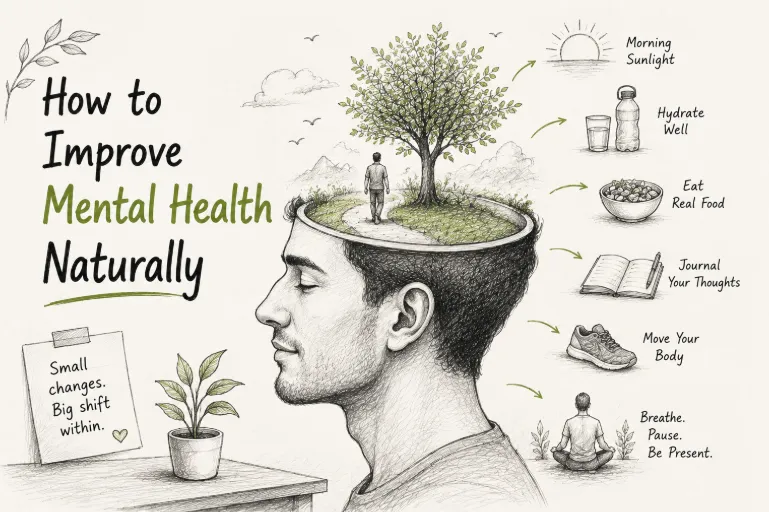

- Pattern First: Mental wellbeing can look different across people, and Ayurvedic concepts such as Vata, Pitta, and Kapha offer a traditional lens for understanding stress and lifestyle patterns.
- Daily Rhythm: Consistent sleep, structured meals, regular movement, calming evenings, and mindful breathing can create a stronger foundation for mental wellbeing.
- Movement and Recovery: Accessible practices such as walking, Surya Namaskar, Yoga Nidra, and Pranayama can support stress regulation without requiring an expensive or complicated routine.
- Personalised Support: Students, professionals, homemakers, and people with limited healthcare access need approaches that fit their realities, while persistent or severe symptoms may require professional mental health support.
Mental health is usually something that requires correction when it gets to be too much, however your daily habits, sleep, diet, physical activity, stress, and even your schedule can have a huge impact on your mind and body. Natural ways to improve your mental wellbeing are not about living according to a perfect schedule. It is about figuring out your needs and making adjustments accordingly.
In this blog, you will find out how concepts from Ayurveda like Dinacharya, Doshas, and Pranayama can become a part of your life and how you can approach nutrition, physical activity, sleep, and stress relief in a more natural way. You will also find out how Ayurveda can be adjusted to suit students, working people, homemakers, entrepreneurs, and individuals with restricted access to professional help.
Understand Your Mental State First
Everyone has their unique experience of mental wellbeing. The same stressor can cause restlessness in one person, irritability in another, and lack of motivation in someone else. Traditionally, Ayurveda uses the terms Vata, Pitta, and Kapha to describe such different patterns.
It is not a system of diagnoses for mental illnesses. However, one can use this traditional framework to assess how his/her lifestyle, stress, sleep, and schedule might affect their state.
Vata pattern:
Traditionally, Vata is connected with activity and changes. The aggravated Vata pattern can be defined by the following features:
- Fast mind that cannot stop thinking and worrying
- Restless and uneasy
- Irregular sleep
- Feeling mentally overstimulated
- Difficulties turning off from work
Imagine yourself having a workday that ends at 10 p.m., but then you keep checking the messages, planning your next day, and going over all the conversations again.
Pitta pattern:
Traditionally, Pitta is associated with the intensity of experience. If under constant stress, it may manifest in:
- Irritability and frustration
- Tendency to perfectionism
- Being upset with anything unexpected
- Competitiveness
- Inability to take a break
Kapiil Guptta has worked with 1,000+ business owners and has seen how high performers can become so accustomed to operating under pressure that they stop recognising how stressed they actually are. What looks like ambition from the outside can sometimes leave very little room for recovery.
Kapha pattern:
Kapha is known for representing stability and heaviness. Imbalance could be identified by the following:
- Lack of motivation
- Withdrawal from actions
- Feeling heavy both psychologically and physically
- More sleeping time than usual
- Feeling blocked
There are numerous possible reasons behind these signs. Lack of motivation and excess sleeping can be caused by depression, lack of proper rest, various health problems, and chronic stress as well. Dosha should never be taken into account when diagnosing any mental disorder.
Look at the pattern before choosing the solution
Kapiil Guptta has also noted that there are business owners who call themselves lazy and unproductive but actually have an environment of working late nights, irregular eating habits, lack of exercise and constant brain stimulation. The first thing that needs to be done is not necessarily finding another activity that will add to your well-being, but recognizing the demands of the routine that you already have on your mind and body.
- Restless and over-stimulated? Sleep patterns, caffeine consumption, amount of work and screen exposure.
- Irritable and driven by constant activity? Work stress and lack of recovery period.
- Heavy and unmotivated? Sleep quality, physical activity and routine. And maybe the professional help.
Vata, Pitta and Kapha are Ayurvedic concepts, not diagnostic categories for depression, anxiety and bipolar disorder. Professional evaluation should be done if changes in mood and behavior are persistent.
- Fix Your Dinacharya
Dinacharya is the Ayurvedic concept of creating a consistent daily rhythm. The idea is simple: when your days have some structure, your body and mind have fewer unpredictable demands to adjust to.
Modern research also highlights the importance of regular sleep timing, circadian rhythms, physical activity, and consistent routines for overall wellbeing. Dinacharya can therefore be viewed as a traditional approach that overlaps with several principles of modern lifestyle science.
Start your day without hurrying
It’s not necessary to wake up at 5 a.m. to live a healthy life. The main thing is to get enough sleep and have a regular schedule.
The easy morning routine includes:
- Waking up regularly
- Getting some natural light
- Having water
- Personal hygiene
- Easy stretching or exercise
- Avoiding unnecessary phone activities
Organize your meals
Your irregular meals will likely become usual during hectic workdays. Eating your meals at regular intervals might help you organize your schedule as well as develop metabolic practices. Instead of snacking all the time or avoiding the lunch completely because of your work, plan the meal intervals that will match your work.
Add movement to your work schedule
Healthy routine doesn’t consist of doing exercises only in the morning. Long hours of sitting may give no place for movement and recovery.The main idea is to make movement an inseparable part of your routine, rather than yet another postponed activity.
Consider taking breaks from working in order to do some:
- Short walking
- Stretching exercises
- Walking during phone calls
- Staircase walking
- Several minutes of movement between work intervals
Create an evening that signals your brain to wind down
The shift from work into sleep needs attention. Notification messages, late night work hours, bright screens, and engaging content keep the brain active at times when it ought to relax.
An easy evening routine may consist of:
- Finishing work at a specific time if possible
- Limiting stimulating screen time before bed
- Maintaining softer lights during the evening
- Having a regular bedtime routine
- Going to bed at a consistent hour
Kapiil Guptta has noticed that people frequently attempt to take better care of themselves by creating additional things to do in a busy schedule. However, the issue is not usually about the absence of healthy behaviors. Rather, it is about having a predictable routine for the healthy behaviors one is already aware of. Rather than introducing ten new things, begin by addressing the greatest disturbance in your day.
- Things to Eat and Things to Reduce
Food is not a treatment for depression or anxiety, but what you eat can influence energy, metabolic health, and overall wellbeing. Research on the gut-brain connection is also growing, although it is still an evolving area of science. The goal is not to follow an expensive wellness diet. For most Indians, it can start with improving the quality of familiar foods already available at home.
Build meals around real, nourishing foods
A balanced Indian meal can include:
- Vegetables and seasonal produce
- Dal, beans, chana, rajma, and other legumes
- Whole grains where suitable
- Eggs, dairy, or other protein sources
- Nuts and seeds
- Fresh fruit
- Minimally processed traditional foods
You do not need exotic ingredients to eat for better health. A simple home-cooked meal can often be a better starting point than constantly searching for the next “superfood.”
Reduce what works against your routine
This is not about labelling foods as completely good or bad. Instead, look at what you are eating frequently and what may be affecting your energy, sleep, or metabolic health.
Consider reducing:
- Highly processed foods
- Frequent packaged snacks
- Excess added sugar
- Large amounts of caffeine, particularly later in the day
- Alcohol, where relevant
The occasional dessert or restaurant meal does not undo a healthy lifestyle. The bigger issue is when convenience foods become the foundation of everyday eating.
Make Indian meals work for you
Breakfast: Poha, upma, idli, dosa, or eggs can be part of a balanced breakfast. Where needed, add a suitable protein source to make the meal more filling.
Lunch: Dal, sabzi, roti or rice, and curd where tolerated can form a simple everyday meal.
Snacking: Fruit, nuts, roasted chana, or other minimally processed options can replace the habit of reaching for packaged snacks every few hours.
The idea is not to completely change the way you eat. It is to make small improvements to the food you already understand and have access to.
- Exercise Accessible to Every Indian
Physical activity does not have to mean joining a gym. For someone dealing with stress, low mood, exhaustion, or a demanding work schedule, the best form of movement may simply be the one they can continue doing consistently.
Research has linked regular physical activity with better mental wellbeing and lower symptoms of depression and anxiety. The goal is not to find the perfect workout. It is to find movement that fits into your actual life.
Surya Namaskar
Surya Namaskar involves a series of 12 yoga poses executed in a continuous manner. Surya Namaskar involves movements and breathing techniques which can be done at home without any equipment.
There have been research studies on yoga practices and the possible impacts on stress, anxiety, and psychological wellbeing. Therefore, Surya Namaskar can be a good practice to incorporate movement into the daily routine. As a beginner, begin slowly and do not attempt to do too many rounds of Surya Namaskar all at once.
- Do a few rounds of Surya Namaskar
- Concentrate on smooth movements and breathing
- Gradually increase the repetitions
- Stop if you feel any pain/dizziness
Walking, Cycling, and Everyday Movement
Workout routine is not necessary to stay physically active; everyday activities count as well. For Indian way of life, physical activities might be like that:
- Taking a walk after a meal
- Using stairs instead of an elevator
- Cycling when traveling short distance
- Walking while talking on phone
- Household activities
- Activity breaks during work at the desk
The walk of 30 minutes does not seem much, but it is more important to keep up with it rather than have a workout routine which will be abandoned after 2 weeks.
Yoga Nidra for Those Who Find Meditation Difficult
Not everyone finds meditation as an easy option. Meditating by sitting down sometimes makes one conscious about the mind he or she wants to clear out. There is another technique for doing this, and it is called yoga nidra. It is a process that is mostly performed lying down with guidance.
It can be useful for someone who finds conventional meditation uncomfortable or difficult to maintain. Research has explored Yoga Nidra and other relaxation-based practices for their potential effects on stress, sleep, and psychological wellbeing. The aim is not to use Yoga Nidra as a cure for a mental health condition. Think of it as another relaxation tool that can become part of a broader routine.
Kapiil Guptta has realized how people tend to complicate physical activities. They look for an appropriate gym, an appropriate coach, or an adequate amount of spare time when they continue to do nothing.
- Pranayama for Stress Regulation
Changing the way we breathe can influence how the body responds to stress. Slow, controlled breathing is commonly used in yoga and relaxation practices and has been studied for its potential effects on stress and psychological wellbeing.
Pranayama should be viewed as a complementary practice, not a replacement for professional treatment for depression or anxiety.
Bhramari: Humming Bee Breath for Stress and Anxiety
Bhramari, often called humming bee breath, involves taking a comfortable breath in and producing a gentle humming sound while breathing out.
The prolonged exhalation and humming can encourage slower, more controlled breathing and may help create a sense of relaxation.
For a beginner:
- Sit comfortably with your back supported.
- Take a gentle breath in through your nose.
- Slowly exhale while making a soft humming sound.
- Repeat for a few rounds without forcing the breath.
- Stop if you feel dizzy or uncomfortable.
Research on yoga-based breathing practices suggests that controlled breathing may help with stress and anxiety symptoms, although evidence varies across different techniques and populations. If you experience panic attacks, severe anxiety, or persistent psychological distress, breathing exercises should complement rather than replace appropriate professional care.
Kapalbhati: Traditional Energisation and Mental Sluggishness
Kapalbhati is an ancient yogic breath exercise that involves forcefully exhaling and then passively inhaling. This breath technique is described in most yoga practices as one that brings energy to the body. However, unlike the slow breathing methods, the Kapalbhati is more vigorous and physically strenuous. One should thus not consider this breath method as a one-stop remedy for bad moods and depression.
For those who have just started practicing this breath exercise, they should learn the technique from a certified instructor and avoid straining their breathing muscles. Some individuals with certain illnesses require expert advice when engaging in forceful breath exercises. For an individual who suffers from daily stress, it may be easier to add a bit of mindfulness breathing into their current routine rather than changing their whole life.
- Improve Sleep
Sleep is not simply time spent resting. Poor sleep can affect concentration, mood, emotional regulation, appetite, physical recovery, and how well you function during the day.
For someone trying to improve their mental wellbeing, sleep is often one of the most important foundations to address before adding more routines, supplements, or productivity techniques.
Ayurvedic Sleep vs Modern Sleep
Ayurveda has traditionally placed importance on regular routines and adequate sleep. Modern sleep science also emphasises consistency and a calming environment before bedtime. The two systems come from different traditions and should not be treated as scientifically identical.
| Ayurvedic principle | Modern sleep principle |
| Regular sleep routine | Consistent sleep and wake timing |
| Calming evening routine | Wind-down routine |
| Reducing stimulation | Limiting stimulating activities before bed |
| Appropriate food timing | Avoiding heavy meals close to bedtime |
Overcoming Sleep Barriers
Improving the quality of sleep isn’t just about putting the phone down. One needs to consider the surroundings in which one sleeps.
Heat: The hot climate of India can make it tough to get good sleep. Proper ventilation, appropriate bedding, cooling the room and making sure the environment for sleep is conducive can make a huge difference.
Noise from joint family: Joint families might have kids and other relatives who come for an overnight stay. It might become tough to sleep uninterrupted due to the noise generated. If possible, make sure that there is a particular window where there will be no noise and tell your family that uninterrupted sleep is important to you.
Screen culture: Night WhatsApp, Instagram, Netflix and endless scrolling can keep the brain active at night. Setting up a cut-off time for screen use can help one create a boundary between work and sleep.
Work culture: For businessmen and other professionals, the day doesn’t end when they turn off their laptops. There can be late night calls, work with international clients, checking up on the dashboard and preparing mentally for the next day.
Having worked with over 1,000 business owners, Kapiil Guptta has seen firsthand how easy it is for people to neglect their sleep as soon as work gets tough; people push themselves to stay awake until they manage to complete one last task, feel exhausted in the morning, and then rely on caffeine to get energy.
It does not necessarily take much to improve your sleep. All you need to do is start by ensuring that your sleep time is secured and you spend calm evenings.
Natural Mental Health Support That Fits Your Life
There is no one-size-fits-all routine for mental well-being. The stress of the student could be due to examinations and pressures whereas the professional working individual might be dealing with deadlines all the time. The homemakers do not get any free time whereas an individual from the rural area does not have access to professional help.
The best way to do things is through a routine that suits one’s life and circumstances.
For Students Under Exam Pressure
Exam preparation can easily turn into a cycle of late nights, excessive caffeine, long hours of sitting, and constant phone use. Add pressure from parents and unrealistic expectations, and studying can become mentally exhausting. A student who studies for ten hours while exhausted may retain less than someone who studies for fewer hours with adequate sleep and recovery.
A student does not necessarily need a complicated wellness routine. A more realistic day can include:
- A consistent sleep schedule
- Short movement breaks between study sessions
- Regular meals instead of relying on caffeine
- Brief periods away from social media
- Short breathing or relaxation breaks
- Reasonable study targets rather than studying endlessly
For Working Professionals and Corporate Burnout
Stress for many professionals doesn’t happen because of one bad day. Stress happens when months of long work hours, busy commutes, alerts, meeting after meeting, lack of food, and insufficient sleep happen.
Even after coming home from work, the work continues. Emails come in at dinnertime. Alerts pop up during family time. The laptop gets shut down, but the mind still works.
Based on his work experience with business owners, Kapiil Guptta has witnessed several times where people take fatigue as an issue of low productivity. Their response is to work even harder, consume caffeine, and sacrifice sleep.
The solution begins with rebuilding the foundations:
- Protecting sleep instead of treating it as leftover time
- Adding movement throughout the workday
- Making meals more regular
- Creating boundaries around work
- Including small periods of genuine recovery
The goal is not to stop being ambitious. It is to build a body and routine that can support the demands of that ambition.
For Homemakers and Women Managing Silent Stress
Not all mental stress is visible. Taking care of one’s family and home, fulfilling responsibilities, always being available leaves almost no room for downtime. In some cases, it is not the issue of lack of knowledge on how to live a healthy life. The issue is that everyone else’s needs come first.
This may include:
- Quick or irregular eating
- Incomplete sleep
- No time to move
- Ongoing mental and household responsibilities
- Little time to oneself
Some women may think of themselves as tired only from managing the house until they realise that the months or even years without recovery have influenced their sleep, energy levels, mood, and motivation to do the things they used to like doing.
Taking care of one’s mental well-being does not necessarily mean adding something new to an already packed schedule. Sometimes it starts with making space for downtime, movement, connecting, or just being alone.
For Rural Indians and Those Without Professional Access
The natural way should not become a costly form of wellness programs that will only be feasible for those who can afford high-end gyms, supplements, fitness gadgets, and retreats. There are various natural practices that one could engage in, which would prove more accessible than some costly ones:
- Walking and physical activity
- Sleep and waking up at consistent hours
- Being outside and having sunlight exposure
- Eating healthy and accessible foods
- Social interaction
- Ancient movement practices
- Basic breathing and relaxation exercises
However, it is important not to mistake accessibility with sufficiency. An individual suffering from serious psychological conditions requires medical help, regardless of accessibility issues. Primary care doctors, governmental health centers, telemedicine, and other resources may serve as avenues for assistance.
Conclusion
Improving your mental health naturally does not require a perfect routine or a complete lifestyle overhaul. Start by understanding what is affecting you and make practical changes to your sleep, food, movement, breathing, and daily rhythm.
You also do not have to figure everything out alone. Kapiil Guptta and the WAYDA team can help you understand your health patterns, identify what may be holding you back, and build a sustainable approach that fits your lifestyle.
Frequently Asked Questions
How to fix mental unstable?
To feel more mentally stable, focus on professional support, daily routines, and healthy coping tools. Reach out to a doctor or a mental health counselor to find the right care plan, which may include talk therapy or medication.
What are five signs that I might need a mental health day?
Five clear signs that you might need a mental health day include constant exhaustion that sleep does not fix, high irritability over tiny issues, trouble focusing or brain fog, physical stress like tight muscles or headaches, and a deep loss of motivation or joy for daily tasks.
What are the most serious mental disorders?
In medical and mental health fields, the most serious conditions are often grouped as Serious Mental Illnesses (SMI). These disorders cause profound, long-term disruption in a person’s thinking, mood, and ability to carry out daily activities. The primary conditions include schizophrenia, bipolar disorder, and major depressive disorder.
What are 5 signs of poor mental wellbeing?
Five core signs of poor mental wellbeing include changes in sleep or appetite, social withdrawal, persistent low energy or fatigue, frequent mood swings or irritability, and difficulty concentrating on daily tasks. Recognizing these behaviors early can help you seek the right support.
Can a person live a normal life with mental illness?
Yes, a person can live a full, productive, and meaningful life with a mental illness. Millions of people manage conditions like depression, anxiety, bipolar disorder, or schizophrenia while maintaining jobs, raising families, and building lasting relationships, especially when they have access to proper care, treatment, and a strong personal support network.
How to know if mentally unwell?
Knowing if you have a mental health issue involves noticing ongoing changes in your thoughts, feelings, and daily behavior that disrupt your ability to work, sleep, or enjoy life. Common warning signs include lasting sadness, extreme mood shifts, social withdrawal, and major changes in eating or sleeping habits.
Read More: The Truth About Intermittent Fasting for Indians
Follow Kapiil Gupta on Instagram for practical health tips, executive wellness strategies, and evidence-based guidance to improve your energy, leadership, and business performance.
Instagram: https://instagram.com/kapiilguptta

Leave a Reply