


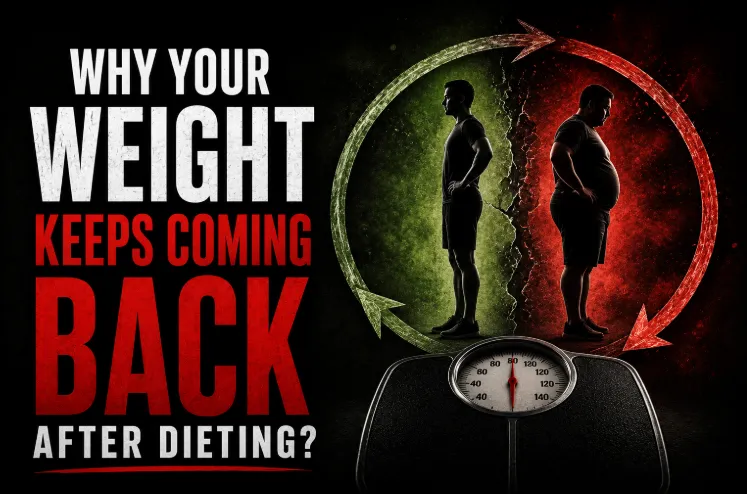
Why Your Weight Keeps Coming Back After Dieting
- Fasting Trap: Rapid weight loss can feel exciting initially because the body drops water weight, bloating reduces, and motivation increases quickly. Over time, repeated restriction may push the body into survival mode, making cravings, fatigue, and weight regain more likely.
- Body’s Survival Response: The body naturally tries to protect a familiar weight range by slowing metabolism, increasing hunger signals, and conserving energy during aggressive dieting. This is often why maintaining lost weight becomes harder than losing it in the first place.
- Root Cause Healing: Weight regain is not always a discipline problem. Factors like stress, poor sleep, anxiety, digestion issues, emotional eating, and chronic overthinking can quietly affect metabolism, cravings, recovery, and long-term consistency.
- Sustainable Transformation: Long-term fat loss usually becomes easier when the focus shifts from quick fixes to supporting metabolism, improving recovery, building realistic eating habits, and creating routines the body can sustain without constant stress or restriction.
Have you ever lost weight, felt proud for a few weeks, started fitting into your old clothes again… and then suddenly watched the weight slowly come back? Maybe even faster than before. You try another diet, skip dinner, start fasting, cut carbs, push yourself harder, but somehow your body keeps returning to the same place. After a point, it stops feeling like a lack of discipline and starts feeling like your body is working against you. The truth is, your body is not weak or lazy. In many cases, it is simply adapting for survival. In this blog, we’ll explore why fasting and quick diets feel magical initially, what the “fasting trap” and set point theory actually mean, and the 5 healing factors your body truly needs to stop the cycle of weight regain.
Why Fasting Feels Magical Initially?
Fasting often works quickly in the beginning, and that’s exactly why so many people emotionally attach themselves to it. Within the first few days, the body starts losing stored glycogen (the carbohydrate stored in muscles and the liver). Since glycogen holds water, this creates a rapid drop on the weighing scale. Studies show that a large portion of initial rapid weight loss during aggressive dieting often comes from glycogen depletion and water loss, not just body fat reduction.
That initial transformation feels exciting:
- The scale starts moving,
- clothes fit slightly better,
- cravings temporarily reduce,
- people around you notice changes,
- and for the first time in months, you feel “in control.”
This creates a powerful emotional high.
For someone who has struggled with weight for years, these quick results can feel like proof that: “Finally, I found something that works,” but this is where many people unknowingly enter the fasting trap.
The problem is not that fasting is “bad.” In fact, fasting can improve insulin sensitivity, reduce overeating in some individuals, and create structure around food habits when done correctly.
The real issue begins when:
- Fasting becomes too aggressive,
- Calories become too low,
- Recovery is ignored,
- Sleep and stress are neglected,
- Muscle loss starts increasing,
- The body interprets rapid weight loss as a threat.
Research shows that after significant calorie restriction, the body begins adapting by lowering energy expenditure and increasing hunger signals. In simple words: your body starts trying to protect itself from further weight loss, and this is why early success can sometimes become dangerous because the faster the body is forced into survival mode, the harder it often fights to regain the lost weight later.
Why Your Weight Keeps Coming Back After Dieting
Your weight keeps coming back, not because you are lazy or weak, but because the body starts adapting to repeated dieting, fasting, stress, and restriction in ways most people never fully understand. Here are the 5 major reasons why this happens.
The Fasting Trap
Fasting often feels magical in the beginning because the changes happen so quickly. Within a short period of time, the weighing scale starts moving down, the body feels lighter, bloating reduces, and many people experience a sense of control around food that they may not have felt in a long time. Along with the physical changes, there is also an emotional shift.
Slowly, this can start showing up in different ways:
- Meals become smaller and eating windows become tighter,
- Energy levels start dropping throughout the day,
- Sleep and recovery may begin to be affected,
- Maintaining the lost weight starts feeling harder than losing it initially.
What feels like a discipline problem on the surface is often the body adapting to repeated restriction and stress in the background.
Body Switches Into Survival Mode
The body naturally prefers stability and safety. Researchers often explain this through something called the “set point theory,” which suggests that the body tries to maintain a familiar weight range over time, especially if that weight has been maintained for years.
Body Weight → Set Point Defence
From the body’s perspective, this response is completely normal. It does not understand that you are trying to “lose weight for aesthetics” or fit into smaller clothes. It only recognises that energy intake has suddenly reduced, and its primary job is to protect you and keep you alive.
Hunger & Cravings Become Stronger
After aggressive dieting or prolonged restriction, the brain and body can slowly start pushing harder toward food as a way of protecting energy and survival. This is one of the reasons why people often feel much hungrier after strict dieting phases, even when they are trying their best to stay disciplined.
This can start showing up in different ways:
- Hunger hormones like ghrelin may begin increasing,
- Highly processed or sugary foods may feel more rewarding,
- Emotional eating may start becoming more common.
This is why many people suddenly feel “out of control” around food after being extremely strict for weeks or months.
Creates Stress Inside The Body
The problem is not just calorie restriction. It is chronic stress.
- Poor sleep increases cravings and recovery issues.
- High stress can worsen fat storage and emotional eating.
- Constant restriction may increase inflammation and fatigue.
- The nervous system can stay stuck in survival mode.
Over time, the body becomes more protective and resistant to change.
Weakens Metabolic Health
Many people lose both fat and muscle during aggressive dieting or repeated fasting cycles. While the number on the scale may go down initially, the body can slowly start becoming more sensitive and protective over time.
- Lower muscle mass can reduce metabolic efficiency.
- Energy levels may decrease over time.
- Future fat loss becomes harder.
- Weight regain often happens faster after repeated cycles.
This is why many people say: “Earlier dieting worked for me. Now nothing works anymore.”
Most people respond to weight regain by trying to push the body even harder. They look for stricter diets, longer fasting windows, detoxes, fat burners, or quick hacks that promise faster results. But in many cases, the problem is not that the body needs more punishment; it is that the body has been under stress for too long.
This is why sustainable fat loss often has less to do with “eating less” and far more to do with helping the body heal, recover, and feel safe again. Factors like metabolism, hormones, sleep, stress, digestion, muscle health, and emotional patterns all play a much bigger role in long-term weight management than most people realize.
So instead of only focusing on faster weight loss, let’s now look at the 5 major healing factors that can help the body recover, regulate itself better, and make long-term fat loss more sustainable.
What Are the 5 Key Healing Factors for Sustainable Weight Loss?
These are the 5 major healing factors that often play the biggest role in long-term weight loss and metabolic health.
Metabolic Healing
Metabolic healing is about helping the body use energy more efficiently instead of constantly trying to conserve it. A healthier metabolism supports better energy levels, improved recovery, muscle preservation, and more sustainable fat loss over time.
This is often supported by:
- eating enough protein,
- maintaining consistent meal patterns,
- preserving muscle mass,
- and avoiding extreme restriction for long periods.
When the metabolism feels supported instead of threatened, the body often becomes more responsive and stable.
Hormonal Healing
Hormonal health plays a major role in regulating hunger, cravings, sleep, energy, recovery, mood, and fat storage. When the body is functioning in balance, it becomes easier to maintain consistent energy levels and a healthier relationship with food.
Healthy hormonal function is closely connected with:
- quality sleep,
- stress management,
- recovery,
- stable eating patterns,
- and overall lifestyle balance.
The goal is not perfect hormones it is creating an environment where the body can regulate itself more effectively.
Nervous System Healing
The nervous system affects far more than most people realize. It influences stress levels, emotional regulation, eating patterns, sleep quality, recovery, and the body’s overall sense of safety.
A more regulated nervous system often supports:
- better emotional control around food,
- improved consistency,
- calmer eating habits,
- deeper recovery, and reduced stress-driven behaviors.
Sometimes, sustainable transformation begins when the body stops feeling like it is constantly under pressure.
Gut & Inflammation Healing
Gut health plays an important role in digestion, nutrient absorption, cravings, inflammation, immunity, and overall energy levels. When digestion improves, the body often feels lighter, more stable, and more responsive.
Supporting gut health may help with:
- better digestion,
- improved energy,
- reduced bloating,
- healthier hunger signals,
- and overall metabolic function.
The digestive system and metabolism are often far more connected than people think.
Behavioral & Identity Healing
Long-term transformation is rarely only physical. The way people think about food, discipline, body image, and health habits also shapes their results over time.
Behavioral and identity healing often involves building:
- sustainable routines,
- healthier food relationships,
- self-awareness,
- consistency,
- and a lifestyle that does not feel built on punishment.
The goal is to create habits that the body and mind can realistically sustain long-term.
How To Stop The Weight Regain Cycle?
Here are 5 practical ways to stop the weight regain cycle by supporting your metabolism, recovery, eating habits, and overall long-term health instead of relying on short-term restriction.
Identify The Root Cause
Sometimes the real issue is not the diet itself. Stress, anxiety, poor sleep, emotional burnout, digestion issues, or hormonal imbalance can quietly affect weight, cravings, and energy levels in the background.
Some practical ways to identify deeper issues include:
- Track patterns in hunger, mood, and energy.
- Observe when cravings become strongest.
- Notice how stress affects eating behaviour.
- Pay attention to sleep quality and recovery.
- Stop copying plans without understanding your own body.
Understanding the root cause often changes the entire approach to weight loss.
Support Your Metabolism
Many people focus only on reducing calories while completely ignoring muscle strength, recovery, and energy levels. Over time, this can make the body feel weaker instead of healthier.
Some practical ways to support metabolism include:
- Eat enough protein throughout the day.
- Include strength training in your weekly routine.
- Avoid staying in very low-calorie diets for long periods.
- Maintain more consistent meal timings.
- Focus on improving strength and stamina gradually.
A stronger body usually manages fat loss better over time.
Improve Recovery
Sleep and recovery influence cravings, energy, mood, and eating behavior far more than most people realize. A constantly exhausted body often struggles with consistency.
Some practical ways to improve recovery include:
- Sleep and wake up at similar times daily.
- Reduce screen exposure before bed.
- Get morning sunlight regularly.
- Take short breaks during stressful workdays.
- Practice slow breathing when feeling overwhelmed.
Recovery helps the body feel more regulated and stable.
Fix Your Food Relationship
Many people unknowingly treat food with fear, guilt, or extreme control. This often creates cycles of restriction followed by overeating.
Some practical ways to improve your relationship with food include:
- Eat meals without distractions whenever possible.
- Stop labelling one meal as a “failure.”
- Avoid all-or-nothing thinking around eating.
- Pay attention to emotional eating triggers.
- Build routines that feel realistic, socially and mentally.
Sustainable eating habits should feel manageable in everyday life.
Build Long-Term Habits
The body responds better to routines that can be maintained consistently over time. Short bursts of motivation rarely create lasting change on their own.
Some practical ways to build sustainable habits include:
- Keep movement part of daily life.
- Start with smaller habits instead of drastic changes.
- Track progress beyond only body weight.
- Give the body time to adapt gradually.
- Focus on routines you can realistically sustain.
Long-term transformation usually looks more consistent than extreme.
A Real-Life Example of Why Root Cause Matters
One of our clients came to us primarily for weight loss. Like many people, he had already tried multiple diets, food restrictions, and fasting methods before. Every time he lost some weight, it eventually came back. Along with this, he constantly struggled with bloating, digestive discomfort, low energy, overthinking, and what he believed was IBS.
He had also started believing that anxiety was simply “part of who he was.” There was a family history of anxiety among the men in his family, and somewhere psychologically, he had accepted that stress, overthinking, and digestive issues were just normal for him.
But after a deeper root cause analysis, we realized something important.
The problem was not simply a lack of discipline or “bad dieting.” In fact, even the IBS assumption was not completely accurate. On further assessment, we identified patterns more closely connected with SIBO (Small Intestinal Bacterial Overgrowth), chronic stress, nervous system overload, and excessive overthinking that had been affecting his digestion, recovery, sleep, cravings, and overall energy levels for years.
Instead of putting him on another extreme diet, the focus shifted toward reducing internal stress and calming the system first.
One of the simplest things we introduced was a very small 60-second ritual before meals and during stressful moments. It sounds extremely basic, but it helped interrupt his constant mental overactivity and slowly improved how his body responded to stress throughout the day.
Along with a more supportive food structure, better recovery, and reduced restriction, his digestion improved, bloating reduced, energy levels increased, and fat loss became much easier to sustain without forcing the body aggressively.
Today, he is not only healthier and leaner, but also running and expanding multiple factories in Jaipur with significantly better energy, mental clarity, and consistency in his lifestyle.
The biggest shift was not another diet. It was identifying the real root cause behind why his body was struggling in the first place.
Conclusion
If your weight keeps coming back after dieting, it does not automatically mean that you are lazy, weak, or lacking discipline. In many cases, the body is simply reacting to years of stress, restriction, poor recovery, emotional pressure, and unsustainable weight-loss methods. Real transformation usually begins when the focus shifts from “How quickly can I lose weight?” to “What does my body actually need to feel healthy, stable, and safe again?”
At WAYDA, Kapiil Gupta and the team focus on identifying the deeper root causes behind weight regain, low energy, cravings, stress, digestive issues, and inconsistent results instead of relying on another restrictive diet plan. If you are tired of losing weight only to gain it back again, it may be time to stop guessing and start understanding what your body actually needs to heal and transform sustainably.
FAQ’s
Why does weight come back after weight loss?
Weight regain is very common after aggressive dieting or repeated fasting cycles. When the body goes through prolonged restriction, it may start slowing metabolism, increasing hunger signals, and conserving energy as a survival response. Poor sleep, stress, muscle loss, and unsustainable habits can also make maintaining weight loss difficult long-term.
Will losing weight lower TSH levels?
In some cases, weight loss may help improve thyroid-related markers. Research has shown that weight loss can significantly reduce FT3 and thyroid-stimulating hormone (TSH) levels while increasing FT4 levels. However, thyroid health also depends on factors like stress, sleep, nutrition, lifestyle, and underlying thyroid conditions.
How to avoid weight regain after dieting?
Avoiding weight regain usually requires a more sustainable approach instead of extreme restriction or repeated crash dieting. Maintaining muscle mass, improving sleep and recovery, managing stress, and building realistic eating habits often support better long-term results. Consistency generally works better than short periods of aggressive dieting followed by burnout.
What are the signs your body is burning fat?
Healthy fat loss is often gradual and supported by improvements in overall health, not just changes on the weighing scale. Common signs may include better energy levels, reduced bloating, improved workout recovery, better sleep quality, increased stamina, and gradual changes in body measurements or clothing fit. Sustainable fat loss usually feels more stable rather than extreme or exhausting.
Related Reading
Wondering whether fasting is helping or hurting your weight loss journey? Discover the science behind intermittent fasting and whether it’s the right approach for Indian lifestyles.
👉 Read More: The Truth About Intermittent Fasting for Indians
Follow Kapiil Gupta on Instagram for evidence-based weight loss tips, nutrition guidance, and sustainable health strategies.
👉 Instagram: https://instagram.com/kapiilguptta